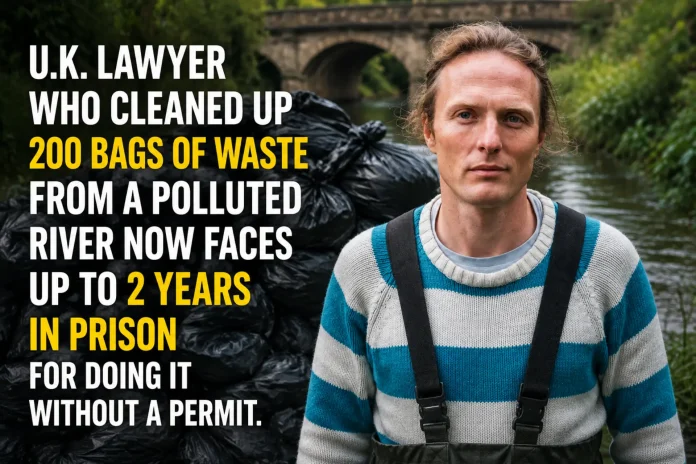
A 40-year-old British barrister who organized volunteers to remove more than 200 bags of waste, silt, and invasive vegetation from a long-neglected river tributary now faces a government investigation that could result in up to two years in prison because the work was carried out without the required official permit.
The viral incident centers on Paul Powlesland, a barrister at Garden Court Chambers who lives on a narrowboat along the River Roding in East London. In late February 2026, Powlesland and a team from the River Roding Trust, the community organization he founded, spent ten days clearing debris from roughly 250 meters of Alders Brook, a tributary that runs through the Barking area on the Essex-London border. The group used manual labor combined with a hired digger that cost the volunteers around 1,000 pounds. The project targeted a section that had become choked with rubbish, branches, silt, and invasive weeds, leaving the water stagnant and ecologically degraded.
Following the cleanup, the restored stretch of the brook began flowing again. Local observers and Powlesland himself reported the return of wildlife, including fish, dragonflies, herons, irises, and reed beds. Powlesland had spent several years repeatedly asking the Environment Agency to address pollution and litter problems in the river system, including upstream sewage discharges from Thames Water and fly-tipping by others. When official action did not materialize, his group stepped in as part of ongoing community restoration efforts that had already included smaller cleanups and tree planting over the previous five years.
• Late February to early March 2026: 10-day volunteer cleanup of Alders Brook
• Within one week of completion: Environment Agency investigators visited the site
• Mid-March 2026: Powlesland received formal notification of the investigation
• June 2026: Story gained widespread attention after details circulated online
The Environment Agency launched its investigation after determining that the removal of silt and waste constituted “unpermitted works” under the Environmental Permitting (England and Wales) Regulations 2016. Officials described the activities as a potential “flood risk activity” because they involved intervention in the riverbed and floodplain. The agency has stated that permits are required to ensure such work does not cause unintended harm to flood defenses, drainage systems, or protected habitats. Powlesland was notified that the site is under investigation for both permitting and waste-related offences, with the maximum penalty for the primary offence being up to two years in prison. As of June 20, 2026, no charges have been formally filed and the matter remains at the investigation stage.
In public statements, Powlesland has defended the cleanup and criticized the agency’s response. He noted that the river section is visibly recovering and argued that the Environment Agency should focus its resources on larger polluters rather than volunteers who are restoring waterways the government had neglected. Powlesland has pledged to continue the restoration work and has invited the agency to collaborate with the River Roding Trust instead of pursuing enforcement. He has also pointed out that his group had offered to share plans in advance so officials could flag any specific concerns, such as rare habitats or infrastructure.
The case raises important questions about the balance between regulatory oversight and citizen-led environmental action. On one side, permitting requirements exist to protect public safety and prevent well-intentioned projects from accidentally damaging ecosystems or increasing flood risk. On the other side, many observers argue it is ethically questionable for authorities to threaten criminal penalties against volunteers who achieve measurable environmental improvements in areas where government agencies have been slow to act. Critics contend that heavy-handed enforcement in this situation could discourage future community involvement and create a chilling effect on grassroots restoration efforts across the country.
Supporters of Powlesland’s approach emphasize that the outcome — a cleaner, flowing waterway with returning wildlife — demonstrates the value of direct action when official channels fail. They question whether the regulations are being applied proportionately when the primary result is ecological benefit rather than harm. At the same time, defenders of the Environment Agency’s position maintain that rules must apply consistently, regardless of intent, to avoid setting precedents that could lead to unregulated interventions with unintended negative consequences. The public reaction online has largely favored Powlesland, with many expressing frustration that bureaucratic processes appear to punish positive outcomes more readily than they address ongoing pollution from major sources.
Powlesland’s background adds context to the dispute. He has long worked at the intersection of law and environmental protection as the founder of Lawyers for Nature, an organization that advocates for legal recognition of ecosystems’ rights. His decision to live on the River Roding and establish the River Roding Trust reflects years of direct engagement with the waterway’s challenges. The current investigation has amplified discussion about whether current permitting systems adequately support or inadvertently hinder the very citizen stewardship that many environmental experts say is essential for restoring neglected urban rivers.