

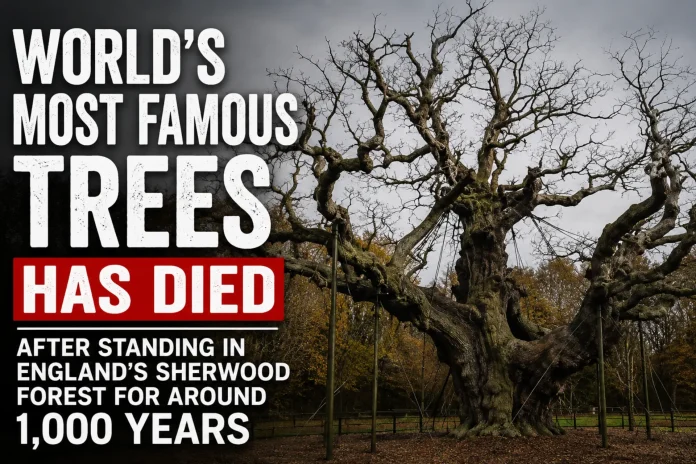
The Major Oak, the legendary tree at the heart of Sherwood Forest, has died. The ancient oak, estimated to be up to 1,200 years old, failed to produce any leaves this spring for the first time in its long history, confirming what conservationists had feared after years of visible decline. The loss brings a quiet but profound end to one of the world’s most famous trees and one of Britain’s most beloved landmarks.
The tree stands near Edwinstowe in Nottinghamshire, England, where it has drawn about 350,000 visitors annually. Site managers at the Royal Society for the Protection of Birds confirmed this week that the oak is no longer biologically active. What makes this loss especially poignant is how deeply the tree had woven itself into British identity, folklore, and the memories of generations who came to stand beneath its canopy.
The Major Oak’s story stretches back long before most nations existed. Local historian Major Hayman Rooke first documented the tree in 1790, describing it as a “majestic ruin” of great antiquity. It was already estimated to be at least 1,000 years old then, and the tree was named in his honor. Before that, locals called it the Cockpen Tree because of cockfights held beneath its branches.
Its connection to Robin Hood is pure legend. While the famous outlaw almost certainly never hid inside the tree, the association stuck. Over the centuries, the hollow trunk grew large enough that, by the 1800s, people served tea inside it. In 1912, suffragettes climbed into the hollow to make their statement. During World War II, the tree served as the formation sign for the 46th Infantry Division.
Sherwood Forest holds one of the finest concentrations of ancient oaks anywhere in Europe. The Major Oak was among the largest, with a girth of about 36 feet (11 metres) and a canopy that once spread 92 feet (28 metres). England alone has 114 living ancient oaks with a girth exceeding nine metres, described by conservationists as “the white rhinos of the UK.” Experts believe the Major Oak may actually be several trees that fused together over centuries, which helps explain its unusual shape and remarkable longevity.
The tree was voted Britain’s favourite tree in 2002 and won England’s Tree of the Year in 2014. It has appeared in documentaries and even inspired a snow formation resembling Friar Tuck in 2010. For many British families, visiting the Major Oak was a childhood pilgrimage, a chance to touch something that had witnessed a millennium of history.
The end came gradually, though final confirmation arrived this week. After years of producing fewer and smaller leaves, the tree produced none at all in 2026. Without foliage, it could no longer photosynthesize or sustain itself. The RSPB, which has managed the site since 2018, announced the news after consulting scientific experts who examined the oak this spring.
Its decline resulted from several pressures. Recent hot, dry summers and heatwaves, including the record-breaking temperatures of 2022, placed enormous stress on the aging oak. Decades of heavy foot traffic from millions of visitors compacted the soil around its roots, restricting water and nutrient flow. Changes to the water table from coal mining beneath the forest also hurt the tree. Most significantly, the elaborate system of metal props and chains installed in 1904 to prevent its massive limbs from falling ultimately worked against the tree. In the 1960s, well-intentioned caretakers also filled hollow parts with concrete and clad limbs with lead, then fiberglass and fire-retardant paint.
Why the supports backfired
As ancient oaks age, they naturally shed large limbs in a process called retrenchment. This allows the tree to conserve energy and water by shrinking into a smaller, more sustainable form. The props prevented this natural process, forcing the Major Oak to keep directing precious resources to branches it would otherwise have released. In its final years, the tree was essentially working against itself. Left alone, ancient oaks retreat into their trunk and require less water and nutrients as they age. The props, while well-intentioned, made that impossible.
Staff at the RSPB exhausted their options. They aerated the soil, added organic matter, installed watering systems, and monitored the tree’s health with scientific precision. Underground tests revealed what estates operations manager Chloe Ryder described as “a strangled and starved root system in total disconnect to its surrounding environment.” Despite their efforts, the combination of age, climate stress, and long-term human intervention proved overwhelming. “It’s heartbreaking. I’m genuinely gutted it’s happened in my lifetime, let alone in my tenure,” Ryder said. “I’ve almost dreaded coming to see it and have that confirmation, and see no leaves on it. I still think it’s one of the most beautiful trees.”
The tree will not be cut down. Instead, it will remain standing as a natural monument and vital habitat. Even in death, ancient oaks support an astonishing array of life. Up to 2,300 species of insects, fungi, birds, and other organisms depend on them at some stage of their life cycle. A quarter of all forest species rely on deadwood at some point. “It still has this totally irreplaceable habitat value,” said Ed Pyne, senior conservation adviser at the Woodland Trust. “It’s still one of the largest trees in Europe and it’s still doing a lot for the ecosystem.”
Staff have been collecting acorns from the Major Oak and growing new saplings. These young trees are being planted across the region, and some have even traveled abroad, carrying the genetic legacy of this legendary oak forward. Dame Judi Dench, patron of the Woodland Trust, recently planted an oak sapling from Sherwood Forest in her own garden and urged the public to press Members of Parliament for stronger legal protections for ancient trees. “The Major Oak’s true legacy is no longer just in folklore, but in the future of conservation,” said Simon Parfey, a soil microbiology specialist who worked with the expert team caring for the tree since 2021.
The bigger picture: This loss extends beyond one tree. It reminds us how fragile even the mightiest natural landmarks have become in the face of climate change and centuries of human presence. The same care that tried to extend the Major Oak’s life also yielded important lessons about how we protect other ancient trees around the world. Stories like the 738-day California standoff to save a 1,000-year-old redwood show that ancient tree conservation has long inspired extraordinary human effort. Yet the Major Oak also reveals that good intentions, without understanding a tree’s natural biology, can sometimes do more harm than good. For the millions who stood beneath its branches, the Major Oak represented something rare: a living connection to a distant past. Its story, from Robin Hood legends to modern conservation battles, shows how deeply humans and nature remain intertwined. While the leaves may be gone, the legend, and the lessons, will endure.
BBC News confirmed the Major Oak’s death after scientific experts examined the tree this spring and found no biological activity. The Guardian reported that the tree had been repeatedly stressed by heat and drought from global heating, particularly the 40C heatwave of July 2022. The official Sherwood Forest visitor site continues to welcome visitors who wish to pay their respects to the ancient oak that has stood at the heart of the forest for centuries.

