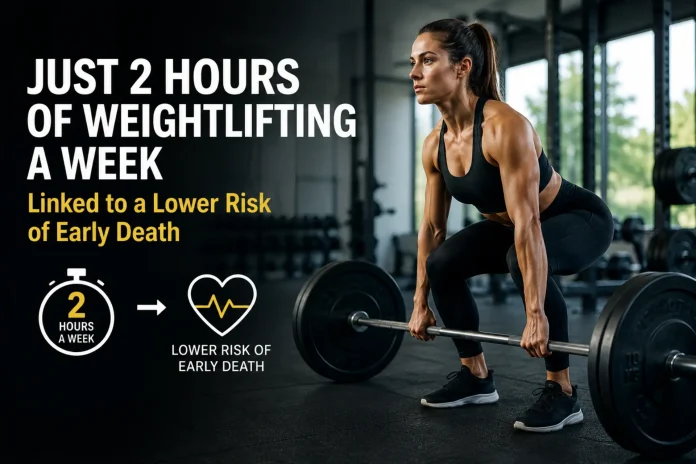
On any given Tuesday evening, you can find people like 52-year-old software engineer David Chen in suburban gyms across America, quietly finishing a 30-minute circuit of squats, presses, and rows before heading home to dinner. New long-term research suggests those consistent sessions are doing far more than building muscle; they are measurably lowering his risk of dying early.
Researchers followed more than 147,000 American adults for up to 30 years and found that adults who performed 90 to 119 minutes of resistance training per week had a 13% lower risk of death from any cause compared to those who did none. The same habit was linked to a 19% reduction in cardiovascular death and a striking 27% drop in mortality from neurological diseases. The benefits stopped increasing beyond roughly two hours a week.
The study, published in the British Journal of Sports Medicine, drew on three major Harvard-led cohorts: the Health Professionals Follow-up Study, the Nurses’ Health Study, and the Nurses’ Health Study II. Participants, both men and women, reported their strength training and aerobic exercise habits every few years through detailed questionnaires. Researchers adjusted for diet, smoking, body weight, and other lifestyle factors, giving the results unusual strength because they tracked real habits over decades rather than relying on single snapshots.
Resistance training delivered clear benefits even for people who already did plenty of cardio. But the biggest gains came from combining both. Those who paired moderate-to-high levels of strength work with substantial aerobic exercise saw their overall mortality risk fall by up to 45% or more compared with inactive people.
Cancer mortality followed a different pattern: only lower doses of resistance training (up to about one hour per week) showed a modest protective link, while higher volumes did not.
The findings strongly support existing public health guidelines that already recommend muscle-strengthening activities at least twice a week. For many busy adults, three or four 30-minute sessions deliver meaningful protection without demanding extreme time commitments or elite-level training.
The research also highlights how different types of movement complement each other. Aerobic exercise strengthens the heart and lungs, while resistance training preserves muscle, supports metabolism, and appears to protect neurological health, a growing concern as populations age, as the muscle loss that can affect even highly trained individuals demonstrates. The data further shows that when it comes to living longer, more is not always better: pushing far beyond two hours of weekly lifting brought no additional reduction in death risk, a pattern that echoes the longevity habits of the world’s oldest people.