

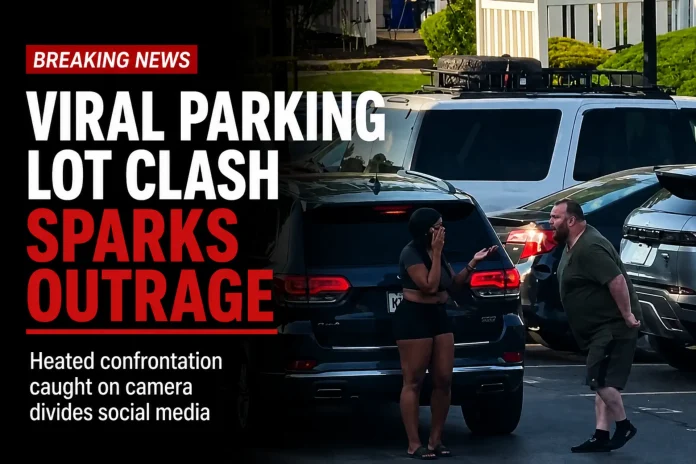
Heavyset Man Confronts Black Woman in New Jersey Parking Lot, Sparking Outrage and Legal Questions
NEW JERSEY — A man has been filmed aggressively confronting a Black woman in a residential parking lot here, with witnesses and the viral video uploader interpreting the encounter as driven by the woman’s race. The roughly nine-second clip, recorded in broad daylight, has circulated widely on social media, though the full circumstances remain unclear and no public police reports have been filed as of this writing.
The video shows the man gesturing animatedly and approaching the woman near her parked Jeep as she spoke on her phone. He wore an olive-green t-shirt and dark shorts; she was dressed in a black crop top and shorts. The encounter took place at a multi-unit residential complex featuring tan siding, white fences, and several parked vehicles. The woman stood her ground while holding her phone to her ear and responding verbally. No explicit racial slurs are audible in the limited audio, and preceding context is absent from the footage.
New Jersey addresses such incidents through its bias intimidation statute, N.J.S.A. 2C:16-1. Bias intimidation occurs when a person commits harassment or terroristic threats with the purpose to intimidate an individual because of race, color, or other protected characteristics. The statute also applies if the offender knows the conduct would cause intimidation on that basis, or if circumstances lead the victim to reasonably believe they were targeted due to a protected characteristic. Under this law, bias intimidation is treated as at minimum a fourth-degree crime, carrying penalties of up to 18 months in prison and fines up to $10,000, with enhancements available depending on the underlying offense. Separate sentences are required for the bias intimidation conviction and any underlying crime.
The incident draws comparison to a 2021 case in nearby Mount Laurel, New Jersey. Edward C. Mathews was recorded on video using racial slurs against Black neighbors during a confrontation that was also captured and shared widely online. According to NBC10 Philadelphia and CBS News Philadelphia, an investigation launched after a neighbor filed a harassment complaint on July 2, 2021, revealed a pattern of alleged stalking, property damage, and harassment spanning multiple neighbors. Mathews later pleaded guilty to four counts of bias intimidation under N.J.S.A. 2C:16-1 and received an eight-year prison sentence with a four-year period of parole ineligibility. Additional charges included possession of a controlled dangerous substance with intent to distribute.
Prosecutors pursuing bias intimidation charges in the current case would need to establish evidence of an underlying qualifying offense alongside proof of bias motivation, according to legal experts. Without additional footage, independent witness statements, or police involvement, authorities face significant challenges demonstrating either intent or that the victim could reasonably perceive the conduct as racially targeted. A heated argument absent a qualifying crime or clear discriminatory language typically falls short of the statutory threshold under New Jersey law.
The episode unfolds against a backdrop of documented suburban racial dynamics. Though New Jersey’s suburbs have grown increasingly diverse, residential patterns often remain highly segregated. Research consistently shows that Black and Hispanic suburban residents disproportionately live in higher-poverty areas than White residents with comparable incomes. Historical factors including redlining, exclusionary zoning, and white flight have shaped community interactions and contributed to perceptions of belonging and exclusion that persist in neighborhoods across the state.
Online responses sharply divided. Many condemned the man’s behavior as unacceptable aggression potentially rooted in prejudice, while others called for additional context, noting that parking disputes or other triggers might explain the confrontation beyond racial animus. The video, posted to X, accumulated thousands of views within hours of circulation.
This case underscores challenges inherent in the digital era, where brief recordings rapidly shape public narratives before full context is available. Assumptions about motive can oversimplify complex interactions that may involve personal frustration, miscommunication, or bias in varying combinations. Communities function best when residents address disputes through dialogue or official channels rather than confrontational encounters. Local authorities should examine any available security footage or resident reports to establish a clearer picture of events. Further developments will depend on official responses, additional witness accounts, or any police involvement in the coming days.

