

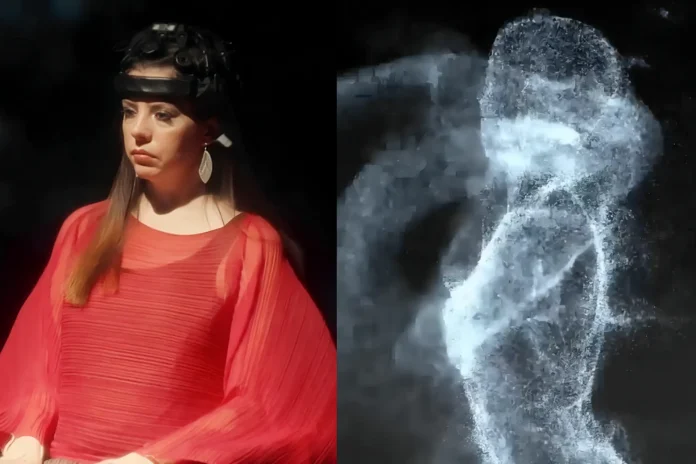
A dancer from Washington state who lost her ability to move because of ALS just danced on stage again using only her brainwaves.
The mother-of-three Breanna Olson made an appearance in Amsterdam’s OBA Theatre in December 2025 as she controlled a glowing avatar through a brain-computer interface that moved and danced along with the real dancers. This was a moment of great glory for Breanna, as evidenced by the standing ovation she got from the audience.
Ballerina and mother-of-three Breanna Olson lives in Tacoma, Washington, where she was born. Growing up, she learned ballet, contemporary, and jazz. She has devoted her entire life to dance. Unfortunately, a little more than two and a half years ago, she was diagnosed with amyotrophic lateral sclerosis, which is sometimes referred to as motor neurone disease. This illness affects the brain and spinal cords’ nerves, gradually removing one’s ability to move while keeping the intellect intact.
A tweet from X.
The performance was part of a show called Waves of Will. Olson appeared on stage wearing the EEG headset. She imagined dancing, and the system turned those brain signals into real-time moves for her mixed-reality avatar. The digital dancer mirrored her style and mood perfectly while live performers danced beside it. Olson later called the night
“exhilarating” and “magical.”
She said,
“I never dreamed that I would be able to dance on stage again. It was just a beautiful and memorable moment I will remember for the rest of my life.”
She added that the standing ovation felt “incredible” and described the tech as “a new way of expression… just freeing.”
The system uses a non-invasive electroencephalogram (EEG) headset developed by Dentsu Lab in collaboration with NTT. It picks up electrical signals in brain when Olson thinks about dance movements. Those motor signals are processed instantly and sent to a computer that drives the digital avatar. Unlike older versions that used muscle sensors, this one runs purely on brainwaves no physical movement required. Dentsu Lab chief creative officer Naoki Tanaka explained the goal:
“There are many brainwave technologies and research all over the world, but most of them are very expensive and not accessible to everyone. This is exactly why we started Waves of Will.”
Americans have followed brain-computer interface breakthroughs closely, especially as companies explore ways to help people with paralysis regain independence. Olson’s story hits home for families dealing with ALS and for anyone fascinated by tech that restores human connection. It shows the mind stays active even when the body cannot.
The Waves of Will project is testing tech that could go far beyond the stage. Future versions might help people control wheelchairs, computers, or even enter digital spaces with just their thoughts. NTT representative Mariko Nakamura said the team sees everyday uses ahead. Olson hopes it changes how society sees people with disabilities. She said,
“Less as sick people or that something is wrong with us, but more like we have value and talents and wisdom… We can do more than we think we can.”
In the end, Breanna Olson didn’t just prove technology can move an avatar she proved the human spirit refuses to stay still.
