

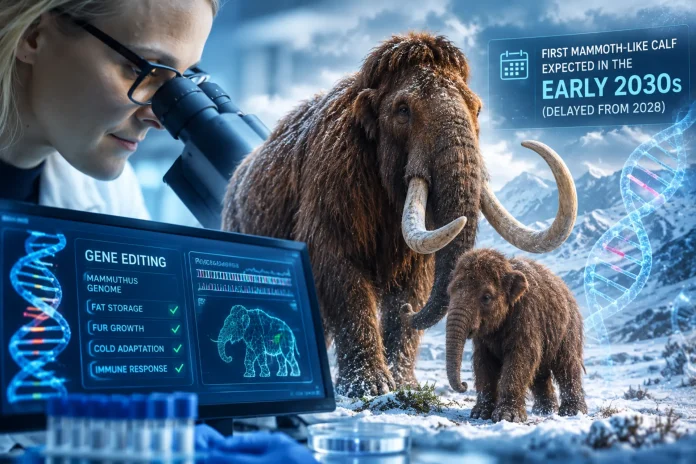
Dallas-based Colossal Biosciences has pushed back the timeline for producing the first woolly mammoth-like calf to the early 2030s, according to CEO and co-founder Ben Lamm in a recent interview with TIME.
“We are thinking it will be in the early 2030s,”
Lamm told the magazine.
“We don’t have a hard date. Not 2036, but not 2030 either.”
The new window reflects how much harder the genetic engineering has turned out to be than the company once expected.
Hypefresh’s earlier report on Colossal’s dire-wolf milestone ran in October 2025 (see related coverage linked below). The Dallas-based de-extinction company had previously told reporters it was aiming for a pregnancy in 2027 and a birth in 2028, with Lamm outlining that 2028 target at SXSW in March 2023. Lamm said the slippage stems from the discovery that far more genetic changes are required than researchers initially projected.
Colossal’s team is using CRISPR gene-editing tools to modify cells from Asian elephants, the closest living relatives of the woolly mammoth. Ancient DNA recovered from permafrost-preserved remains guides the edits, which aim to introduce traits such as dense fur, smaller ears, thicker fat layers and other cold-adapted features that defined the extinct species. The approach rests on a body of work that George Church, the Harvard geneticist who co-founded Colossal with Lamm, began more than a decade ago.
Early estimates suggested roughly 60 gene edits would suffice to shift an elephant cell toward mammoth-like characteristics. Church’s Harvard lab zeroed in on 60 genes as far back as 2015 and reported in 2017 that it had successfully added 45 genes to the genome of an Asian elephant. According to Lamm’s TIME interview, that figure later rose to the range of 65 to 85, and current assessments now indicate more than 150 genes will need modification to produce a cold-adapted elephant.
The resulting animal would not be a pure genetic copy of the woolly mammoth. The last surviving population of woolly mammoths, isolated on Wrangel Island in the Arctic Ocean, died out about 4,000 years ago. Colossal describes the goal as a cold-resistant elephant carrying the core biological traits of the woolly mammoth, what Church has called a “mammophant.”
Artificial intelligence is assisting the work by analyzing comparative genomes and refining the list of gene targets. Colossal spun out its software platform Form Bio in September 2022 with $30 million in funding to support this kind of genomic research, and the company continues to integrate AI tooling across its pipeline. In April 2024, Form Bio researchers also discovered a microbe, X-32, capable of breaking down various plastics in as little as 22 months while leaving behind carbon dioxide, water and biomass.
Colossal has already demonstrated progress with related experiments. In March 2025, the firm announced a cohort of gene-edited “woolly mice” with mutations inspired by woolly mammoths. The mice, which exhibit long, shaggy, tawny-toned fur, were developed using a mix of mammoth-like and known mouse hair-growth mutations. Some outside experts expressed skepticism at the time, arguing the experiment was more about mouse genetics than a breakthrough in de-extinction. In April 2025, the company announced the birth of three genetically modified wolf pups, Romulus, Remus and Khaleesi, through its Dire Wolf Project, using cloning and gene editing to introduce 14 key gene changes that expressed 20 traits claimed to represent the dire wolf phenotype. In-house scientists had analyzed the dire wolf genome, extracted from a 13,000-year-old tooth and a 72,000-year-old ear bone, before isolating cells from gray wolf blood samples.
Significant hurdles remain. Asian elephants carry their young for about 22 months, one of the longest gestation periods of any land mammal. Developing viable embryos, securing suitable surrogates and ensuring animal welfare present ongoing technical and logistical challenges. Colossal is exploring artificial womb technology in parallel, though that work is still experimental for large mammals. In January 2025 the company announced a prototype for an artificial uterus used to culture fertilized single-cell marsupial embryos to over halfway through pregnancy, an early proof-of-concept for a technique that could eventually replace live elephant surrogates.
Colossal Biosciences was officially launched on September 13, 2021 by Lamm, a serial entrepreneur, and Harvard geneticist George Church. The company has raised $435 million in total funding as of January 2025, when its $200 million Series C round pushed its valuation to $10.2 billion and made it Texas’ first decacorn. Beyond the woolly mammoth, Colossal is pursuing additional de-extinction projects involving the dodo, the Tasmanian tiger (thylacine), the dire wolf, the moa and the bluebuck.
Lamm has repeatedly framed the mammoth effort as both a scientific milestone and a potential contributor to Arctic ecosystem restoration, alongside broader conservation technologies that could aid living elephants. Church presented his de-extinction idea at the National Geographic Society in 2013, mapping out what would later become Colossal. Colossal was named to TIME’s 100 Most Influential Companies list in 2023.
The work has drawn skepticism from outside researchers. Some geneticists and conservationists have called the project a “fantasy” given the poor and fragmentary preservation of ancient DNA, arguing the money could be better spent on conserving living ecosystems. Ancient-DNA professor Jeremy Austin has suggested Colossal’s efforts are “more about media attention for the scientists and less about doing serious science.” In July 2025, New Scientist revealed that some academics who have publicly criticized Colossal’s work, including Vincent Lynch, Flint Dibble, Victoria Herridge and Nic Rawlence, have been the subject of an apparently coordinated smear campaign involving AI-generated blog posts and bogus YouTube copyright strikes; Colossal has denied involvement, telling the outlet that neither the company nor its investors commissioned the negative stories.
Lamm has tied the expanded gene list and the revised timeline to deeper analysis of mammoth and elephant genomes. The company continues work on cell editing, embryo development and reproductive methods while refining its genetic targets with the help of AI-driven analysis, and plans further studies on the woolly mice’s cold tolerance and long-term health as it works toward a mammoth-like calf sometime in the next decade.
The mammoth effort sits inside a wider CRISPR-driven wave of de-extinction research, and the early-2030s target is now the most concrete public benchmark the team has set since its 2021 launch.

