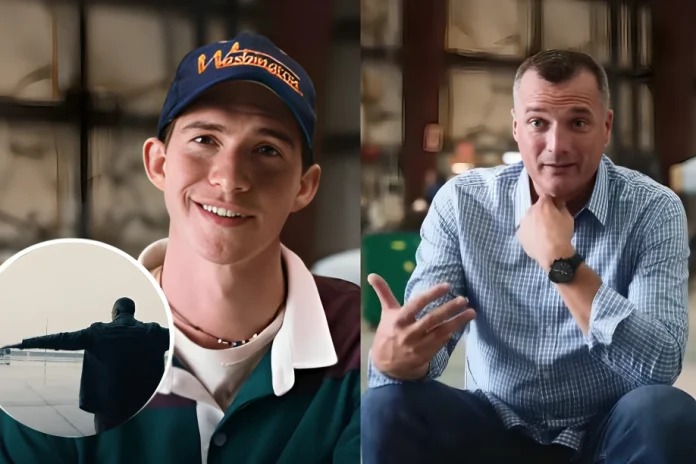
A nearly 30-year-old marketing blunder that became a legend in consumer law has found new life — and a new ending — thanks to Frontier Airlines’ Super Bowl 2026 commercial.
During the game, the low-cost carrier aired a 30-second spot recreating one of the most famous advertising controversies of the 1990s: John Leonard’s failed attempt to claim a U.S. military fighter jet from Pepsi. This time, however, the story ends with a reward Leonard never received back then — a symbolic redemption in the form of lifetime flights.
The saga began in 1996, when Pepsi launched its “Pepsi Stuff” loyalty campaign. Consumers could collect Pepsi Points from soda packaging and redeem them for merchandise listed in a catalog. To promote the campaign, Pepsi aired a television commercial showing a teenager acquiring rewards step by step: a T-shirt for 75 points, a leather jacket for 1,450 points, and — as the punchline — a Harrier fighter jet for 7 million Pepsi Points.
The commercial showed the teen landing the jet at school, with the caption: “HARRIER FIGHTER 7,000,000 PEPSI POINTS.” There was no disclaimer indicating the jet was a joke.
John Leonard, then a 21-year-old college student from Seattle, took the offer seriously. After reviewing the campaign rules, which allowed consumers to purchase additional points for 10 cents each, Leonard raised investment capital and sent Pepsi a check for more than $700,000 to cover the required points. He formally requested delivery of the jet.
Pepsi refused, calling the jet an obvious joke and returning Leonard’s check. The company later added a disclaimer to the commercial. Leonard sued.
In Leonard v. Pepsico, Inc., federal courts ruled in Pepsi’s favor, concluding that no “reasonable person” would believe the ad was a genuine contractual offer. The case went on to become a staple example in law school textbooks, illustrating advertising “puffery” and the objective standard in contract law.
For years, the case lingered as a niche legal anecdote — until Netflix released the 2022 docuseries Pepsi, Where’s My Jet? The four-part series reexamined the dispute, featuring Leonard himself and framing the story as a David-versus-Goliath battle from the height of the cola wars.

The documentary reignited public interest introduced the story to a younger audience, and sparked renewed debate over whether Pepsi should have handled the situation differently. It also made Leonard something of a cult figure in marketing and consumer culture circles.
Frontier Airlines’ Super Bowl ad directly taps into that renewed awareness.
Styled with deliberate 1990s nostalgia, the commercial opens with retro soda imagery and clips evoking the original Pepsi ad. An adult Leonard is shown walking through aircraft hangar doors toward a bright reveal. A narrator intones: “Thirty years ago, a man tried to trade 7 million soda points for a jet. It didn’t happen… until now.”
Instead of a fighter jet, Leonard is presented with 7 million Frontier Miles — an amount the airline says is effectively enough for lifetime free flights within its network.
The spot then expands beyond Leonard’s story. Frontier announces a broader promotion, giving away 70 million miles total and allowing customers to convert unused loyalty points from virtually any brand — including airlines, hotels, and credit card programs — into Frontier miles.
The message is clear: where Pepsi once said no, Frontier says yes.
Marketing analysts quickly praised the campaign as a smart blend of nostalgia, pop culture timing, and brand positioning. By aligning itself with a well-known consumer grievance — and offering a tangible, real-world payoff — Frontier managed to stand out in a Super Bowl crowded with high-budget ads.
Leonard never received a fighter jet, and the courts firmly sided with Pepsi decades ago. But with Frontier’s Super Bowl moment, his story has come full circle — transformed from a legal loss into a marketing myth with a feel-good ending.
In an era where nostalgia and brand storytelling increasingly drive consumer engagement, Frontier Airlines has turned one of advertising’s most infamous jokes into a modern promotional triumph — proving that sometimes, redemption doesn’t come from the courts, but from clever marketing three decades later.