

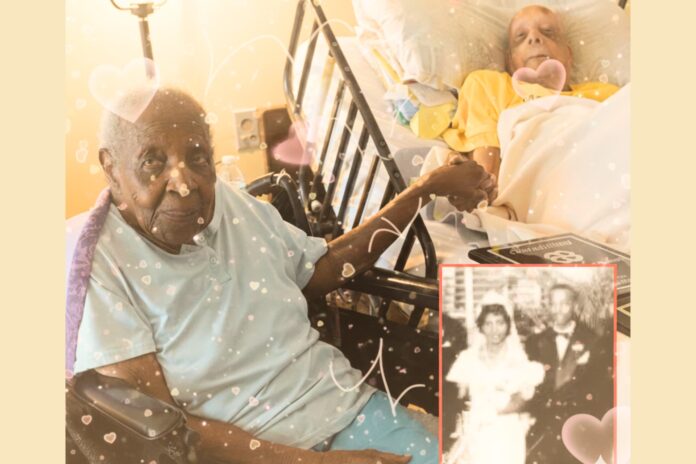
In a world racing toward fleeting connections and disposable vows, imagine two hands—wrinkled yet intertwined like ancient roots—holding firm across eight decades of storms, proving that love isn’t just a word, but a quiet revolution against time itself.
Lyle and Eleanor Gittens, now 108 and 107, felt that revolution ignited on a crisp autumn evening in 1941 at Clark Atlanta University in Atlanta, Georgia. Eleanor, a poised 23-year-old fresh from earning her bachelor’s in education, slipped into the gymnasium not for the roar of the crowd or the squeak of sneakers on polished wood, but for him: Lyle, the 24-year-old star forward whose every leap seemed to defy gravity and the heavy air of segregation outside those walls. She watched as he dribbled past defenders from rival Morehouse College, sweat glistening under the harsh lights, his focus unbreakable; in that moment, amid cheers from fellow Black students dreaming big in a Jim Crow South, their eyes locked, and Eleanor later recalled in her own words, “It was love at first sight—I loved him, he loved me, and that was it.” What started as stolen glances evolved into moonlit walks across campus lawns scented with magnolia blooms, shared dreams whispered over cafeteria trays of cornbread and collards, and dances where Lyle’s strong arms guided her through swings that made the world feel conquerable, even as war drums echoed faintly from across the Atlantic.
Key Moment: A single glance across the basketball court, turning rivals’ cheers into the soundtrack of their forever.
By spring 1942, those dreams sharpened into urgency as Pearl Harbor’s shadow lengthened over America. Lyle, patriotic and restless, enlisted in the U.S. Army, trading his basketball jersey for a uniform in the all-Black 92nd Infantry Division, known as the Buffalo Soldiers. He secured a rare three-day pass from basic training at Fort Benning, Georgia, just enough time to rush to Bradenton, Florida—Eleanor’s sun-soaked hometown, where palm fronds rustled like applause. On June 4, their wedding unfolded in a modest ceremony at her family’s home, the air thick with the salty tang of the Gulf nearby and the aroma of her mother’s fresh-baked sweet potato pie; Lyle, meeting her relatives for the first time, stood tall in his pressed suit, exchanging vows under a makeshift arch of wild jasmine while Eleanor, radiant in a simple white gown borrowed from a cousin, wondered aloud in her heart if she’d ever feel his touch again. Their honeymoon was a hurried blur—a single night in a quiet inn, bodies close against the creak of floorboards, laughter mingling with the distant hum of wartime radios—before Lyle boarded a train north, leaving Eleanor with a kiss that tasted of farewell and a promise etched in his eyes.
The war tore them apart like a censor’s black ink across a letter, stretching their separation to three agonizing years from 1942 to 1945. Eleanor, pregnant with their first child, Lyle Rogers, born in the chill of a New York winter in 1943, packed her bags and headed north to live with Lyle’s family in Brooklyn, the city’s pulse a stark contrast to Bradenton’s lazy rivers. She took a job in payroll at an aircraft parts factory, her fingers flying over adding machines amid the clang of metal and the acrid smell of solder, all while her belly swelled. Letters arrived sporadically—hers full of tender pleas and updates on the baby’s kicks, his reduced to fragmented declarations like “I love you” amid vast redactions that left her staring at blank spaces, heart pounding with dread on days like April 12, 1945, when a wave of unexplained fear washed over her at her workbench. Meanwhile, Lyle endured the mud-choked Apennine Mountains in Italy, rifle in hand during brutal skirmishes where bullets whistled like vengeful spirits and the cold seeped into bones; he earned quiet honors for bravery, pulling comrades from crossfire under olive groves heavy with the scent of gunpowder and earth, all the while clutching Eleanor’s photo like a talisman against the isolation of a segregated unit far from home.
Reunion came in the humid haze of summer 1945, when Lyle stepped off a ship in New York Harbor, the Statue of Liberty’s torch a beacon through his weary eyes, and Eleanor waited on the docks, their son toddling at her side in a starched sailor suit. They collapsed into each other amid the chaos of honking taxis and newsboys hawking victory headlines, tears salting the joy as Lyle lifted his boy for the first time, inhaling the milky scent of infancy that had bloomed in his absence. Settling into a modest Brooklyn apartment where brownstones stood shoulder-to-shoulder like steadfast friends, they aced the civil service exam together, landing parallel government jobs that filled their days with the steady rhythm of typewriters and policy memos—Lyle in administrative roles that honed his quiet leadership, Eleanor balancing clerical duties with the chaos of raising young Lyle amid playground echoes and the sizzle of Sunday roasts. As daughters Angela and Ignae arrived in the late 1940s, their home swelled with the laughter of three children scrambling over threadbare rugs, bedtime stories laced with tales of Atlanta courts and Italian hills, and evening rituals where martinis clinked like toasts to survival, the amber liquid warming throats as they unpacked the day’s burdens under the glow of a single lamp.
Decades unfolded like chapters in Eleanor’s own memoir, a three-part saga she penned at 104 for The Westside Gazette, capturing the poetry of their shared grind. In the 1950s and 60s, they navigated Brooklyn’s bustling streets—Lyle missing the city’s electric hum even as he retired after 30 years, trading spreadsheets for veteran hall gatherings where war stories mingled with cigar smoke; Eleanor, undeterred by age, dove into academia, commuting to Fordham University at 69 to earn her PhD in urban education, her thesis pages alive with arguments for equity that drew from nights poring over books while children slept. Family holidays brimmed with the chaos of 10 grandchildren tumbling through doorways, plates piled high with Eleanor’s gumbo that carried the spice of her Florida roots, and Lyle’s booming laughter recounting basketball glory—he’d been inducted into Clark Atlanta University’s Men’s Basketball Hall of Fame, a plaque that hung like a crown in their living room. Travels to Guadeloupe dotted their calendar, where turquoise waves lapped at volcanic sands and they danced under starlit skies, hands clasped as always, even as the world evolved around them with civil rights marches they supported from afar, mailing checks to causes that echoed their own quiet defiance.
By the late 2010s, the pull of time drew them south to Miami, trading Brooklyn’s fire escapes for Angela’s sun-drenched home, where ceiling fans whispered overhead and the ocean’s roar provided a soothing lullaby. Now in their centenarian years, health’s frailties crept in—Lyle’s recent fall leading to a hospital stay in early November 2025, where monitors beeped like impatient metronomes and antiseptic sharpness hung in the air—but even there, on November 4, as Guinness World Records verified their titles for oldest living married couple by aggregate age (216 years, 132 days) and longest marriage for a living couple (83 years), they held hands across the bedrail, faded wedding photo propped nearby like a sentinel. The image, paired with that bedside tenderness, exploded across social media, amassing over 29,000 likes in a cascade of comments celebrating Black love’s unyielding flame—from strangers sharing their own vows renewed to families toasting “till death do us part” over virtual glasses. Grandson Hasani, a journalist in his own right, amplified the moment, crediting them for lessons in “intelligence, worldliness, and good food,” weaving their story into a tapestry of generational pride through his posts.
Record-Breaking Bond: Love, love, love – their simple mantra, now etched in history.
Yet beyond the records lies a deeper pulse: in an age where apps promise instant sparks but deliver hollow echoes, Lyle and Eleanor’s blueprint—love, love, love, as Eleanor distills it, or “We just love each other,” with Lyle’s wry nod to her cooking as his fountain of youth—feels like a radical act of rebellion. They’ve never slept mad, she confides, resolving spats over morning coffee that still brews strong, or shared a Modelo beer at lunch, foam fizzing like their enduring spark; it’s this deliberate tenderness, forged in war’s forge and tempered by routine, that outshines any headline. As a society wrestling with fractured bonds and historical scars, their journey as a Black couple from Jim Crow’s grip to global icons urges us toward vulnerability—not as weakness, but as the most actual strength, a reminder that real intimacy builds slowly, like roots delving deep into unyielding soil.
For anyone chasing the science of such spans, LongeviQuest offers verified windows into supercentenarian worlds, blending data with the human grit that stories like theirs embody. And as Lyle navigates his smartphone at 108 to text grandchildren memes, or Eleanor plots a final pilgrimage to Clark Atlanta’s courts where it all began, their unfinished memoir whispers a final truth: some loves don’t fade—they evolve, hand in hand, into legends we all yearn to live.
 and Eleanor (107) Gittens hold the world record with 216 years combined and 83 years of marriage — here’s how they did it.)