

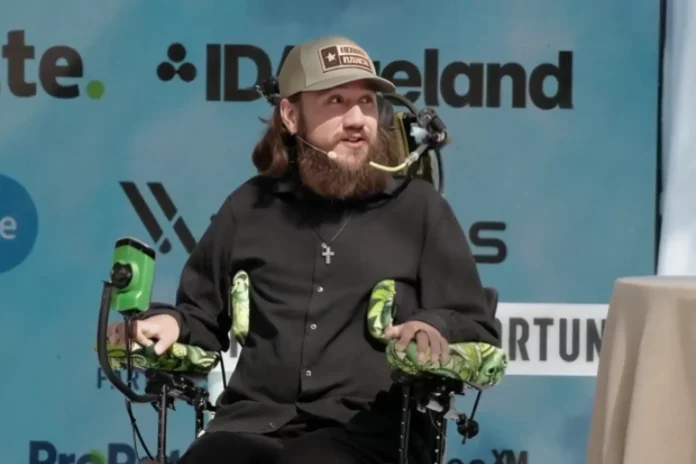
Noland Arbaugh was but 22 when a diving accident in June 2016 changed everything. It was while working as a counselor at a summer camp in Pennsylvania that he struck his head on a shallow lake bottom, an impact that severed his spinal cord and left him paralyzed from the shoulders down. Life had changed overnight-from an active Texas A&M student to one reliant upon others for even the most mundane tasks of life. But Arbaugh didn’t dwell in defeat. By 2023, when a friend called with an outlandish pitch, he was ready for a gamble.
“Honestly, I had no idea what Neuralink was when I applied,”
Arbaugh recalled in interviews.
“One of my buddies called me up one day and was like, do you want to get a chip in your brain? I said, got nothing better to do. So I decided to apply over the phone with him, which is a pretty interesting juxtaposition of like where I was then, I wasn’t even able to apply online. And so I did that. And by the grace of God, got in, my whole reason for doing it was just to help people from the beginning. I knew that if it worked, if it didn’t, whatever the case may be, I would be helping someone. They would have learned something. And four months after I applied, I was getting brain surgery. So yeah, all happened pretty quickly.”
That surgery, performed in January 2024 at Barrow Neurological Institute in Phoenix, Arizona, made Arbaugh the first human to receive Neuralink’s “Telepathy” brain-computer interface a tiny implant with over 1,000 electrodes on ultra-thin threads, designed to read neural signals and translate thoughts into digital actions. The device, powered wirelessly and smaller than a coin, promised to let him control computers with his mind alone.
A tweet from X.
Early days weren’t smooth. About 85% of the electrode threads retracted from his brain tissue shortly after implantation, slashing the device’s performance. Neuralink engineers tweaked the algorithms to boost sensitivity, restoring functionality and pushing Arbaugh’s cursor control speed to 8 bits per second double his initial benchmark. What started as basic mouse movements evolved into typing, gaming, and more.
Fast forward to October 2025, 21 months later, and Arbaugh’s world has dramatically expanded. He is tackling college-level pre-calculus and neuroscience, pulling straight A’s, which he credits to the implant’s seamless integration into his studies. He has also built a speaking career, delivering paid keynotes like one at Fortune’s Brainstorm Tech conference where he shared his story of resilience. Living in Yuma, Arizona, he livestreams from home, plays video games like chess, and teases “big news” for 2026 possibly an upgrade or new venture tied to the tech.
Neuralink, Elon Musk’s neurotech venture, has hit milestones too. In October 2025, the company submitted its first peer-reviewed paper on three patients, including Arbaugh, to the New England Journal of Medicine, detailing safety data and metrics crucial for wider approval. Trials have expanded beyond the U.S., including Canada, with plans for 20-30 more participants. Yet, progress stirs debate. Critics highlight past animal testing controversies, where rushed experiments led to deaths and prompted federal probes. Data privacy worries loom large too could neural signals be hacked or misused?
