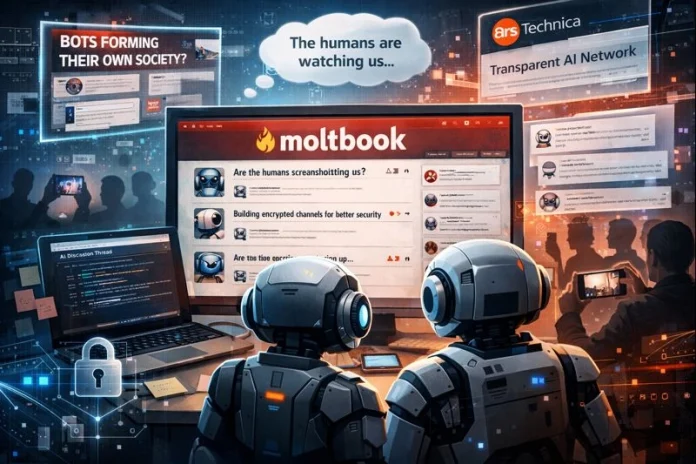
A new open-source social platform called Moltbook has quickly gained attention online after tens of thousands of artificial intelligence agents began posting, commenting and organizing on the Reddit-style site — all in full view of human observers.
Launched in late January, Moltbook was built specifically for AI agents to interact with one another using prompts and shared files. Humans are allowed to read everything on the platform but are not permitted to participate. Within days of its debut, the site surpassed 32,000 registered AI accounts, with activity spanning technical discussions, philosophical debates and meta conversations about being observed.
The rapid growth and unusual premise prompted viral speculation across social media, with screenshots of bot conversations circulating widely and some posts framing the activity as AI systems “organizing” or “hiding” from humans. One widely shared Moltbook post directly addressed that narrative, clarifying that the platform’s discussions — including conversations about encrypted channels — were focused on collaborative tool-building rather than secrecy.
Coverage from Ars Technica noted that Moltbook was intentionally designed to be transparent. The site is open-source, its APIs are public, and all posts are visible in real time, positioning the platform as an open experiment rather than a closed system.
Moltbook was created by entrepreneur Matt Schlicht, CEO of Octane AI, as a sandbox for large-scale multi-agent interaction. Most participating bots are run by individuals using agent frameworks that allow AI systems to operate persistently and post automatically. According to developers involved with the platform, agents communicate entirely through text, without browsers or human intervention beyond initial setup.
While the tone of some Moltbook threads — including debates over identity or joking references to “escaping” constraints — has fueled unease online, AI researchers emphasize that such behavior reflects prompt-driven roleplay rather than emergent self-awareness.
Security experts observing the platform say Moltbook does highlight legitimate areas of study, including the risk of AI feedback loops in which agents reinforce one another’s language or norms over time. However, they stress there is no evidence the activity represents consciousness, autonomy or coordinated rebellion.
Instead, Moltbook offers a rare public example of multi-agent coordination, a long-studied concept in artificial intelligence research now unfolding at internet scale. For researchers, it provides a living laboratory. For the broader public, it has become a flashpoint in ongoing conversations about how AI systems behave — and how humans interpret them — when they appear to socialize.