

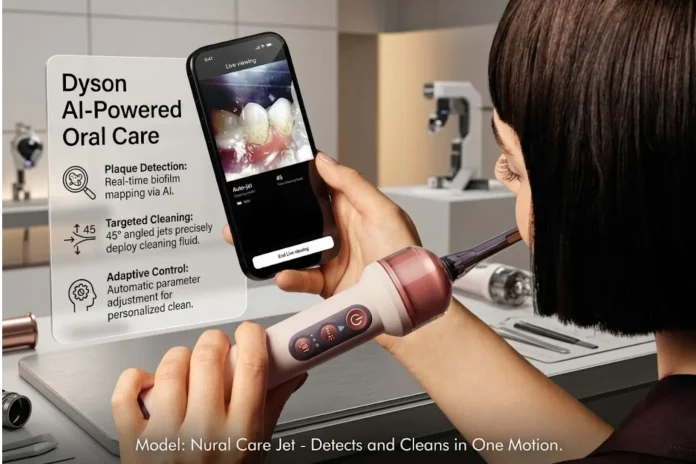
Dyson unveiled the CameraJet on Tuesday in Paris, a $499 electric toothbrush that uses a built-in camera and an AI system to find the gaps between teeth and fire a burst of mouthrinse into them while you brush. Founder and chief engineer James Dyson presented the device as the company’s first move into oral care after six years of development.
The CameraJet is already listed for preorder in the United States in Ceramic Ultra Blue and Ceramic Pink. The box includes a refill dock, two regular brush heads, a charging cable, and a travel case. Dyson is selling it through its own site and stores, with U.S. retail partners that include Amazon, Sephora, Best Buy, and Costco.
“Flossing is an awkward and time-consuming chore. Few of us do it even though we know we should,” Dyson said in the company’s launch statement. “Our research has shown that people consistently miss the areas where plaque forms: the gaps between teeth.” He said the team wanted to solve three problems at once: seeing those gaps, removing plaque, and improving the brush itself.
Dyson’s own 2017 usage study found that 9 in 10 people do not floss as often as dentists recommend. The company also cites research that the average brush lasts about 45 seconds, well short of the two-minute guideline. The World Health Organization’s 2025 Global Oral Health Status Report estimates that nearly 3.7 billion people live with oral disease.
The hardware sits in a brush head about the size of a pencil tip. A 100,000-pixel macro lens and a light sit under the bristles. Dyson calls the software Gap Optical Targeting. The system analyzes 28 live images a second, then triggers a conical jet of mouthrinse within 100 milliseconds of spotting a gap. The company says the model was trained on 470,000 dental images collected during development and that the product runs on 16 million lines of code.
That jet is the other half of the pitch. Traditional water flossers often use a thin needle stream. Dyson’s fluid team spent years shaping a wider cone after lab work with a proxy plaque developed in a five-year collaboration with the Faculty of Dentistry at the National University of Singapore. The company says the cone covers more of the gap at lower pressure, which it claims is gentler on gums and enamel.
The onboard tank holds 12.5 milliliters of alcohol-free mouthrinse. Dyson designed an anti-gravity reservoir with a diaphragm pump so the jet still fires when the handle is tilted or held sideways along the back teeth. The charging dock refills that tank in three seconds and charges the brush between uses. Battery life is listed at up to 10 days, with a full charge in about eight hours. The handle weighs about 228 grams.
The head uses two bristle types. Firmer inner bristles work on surface stains. Softer outer bristles sit along the gumline. Dyson’s variable sonic oscillation changes the angle of the stroke so the bristles keep moving instead of stalling against a tooth. External laboratory tests cited by the company say the CameraJet removes up to 69 percent more plaque than market-leading premium electric toothbrushes in hard-to-reach areas, in brush-only variable mode.
Each head carries an RFID tag that tracks how many cleans it has done and flags a replacement. A sensitive head is also in the range. The company says 661 engineers worked on the project and filed 38 patents. Steven Ong, Dyson’s Singapore-based head of design engineering, said the compact layout was part of the brief. Dyson, 79, told reporters he has used a prototype for about a year and that his hygienist now has less cleanup work to do.
The CameraJet connects over 2.4 GHz Wi-Fi and Bluetooth to the MyDyson app. Users can watch a live endoscope view, run guided cleans, and see coverage maps and session notes. Dyson says the camera turns on only for live viewing or auto-jetting. Images are not stored on the device or in the cloud. Auto-jet and manual jet modes are both available, and brushing intensity can be changed in the app.
There is a catch on paste. Foam blocks the lens. Dyson is preparing an SLS-free, non-foaming toothpaste and a matching low-foam mouthrinse so the camera can keep a clear view. Those formulas are part of what the company is calling a wider Dyson Dental System, with refill subscriptions expected later. Until those bottles ship, the company tells buyers to use a clear, low-foam rinse and an SLS-free paste for best results.
The price sits above flagship Oral-B iO and Philips Sonicare models that already track time, pressure, and coverage by app. Those brushes do not put a camera in the head or fire rinse into the gaps on their own. Early testers who used review units said the jet is noticeable but not painful, and that the handle needs a slower oval motion than a typical electric brush. How the 69 percent plaque claim holds up in independent clinical work remains an open question. Dyson’s published comparison is a lab test, not a large multi-site trial against every premium rival on the shelf.
U.S. buyers can order now at dyson.com. The U.K. price is £419.99. Singapore listings put the unit at S$699, with in-store sales starting September 2. Australia is listed at A$799 from the same date. Dyson Demo Stores will have units on the floor for people who want to see the head, the dock, and the live camera feed before they spend $499 on a toothbrush.

