

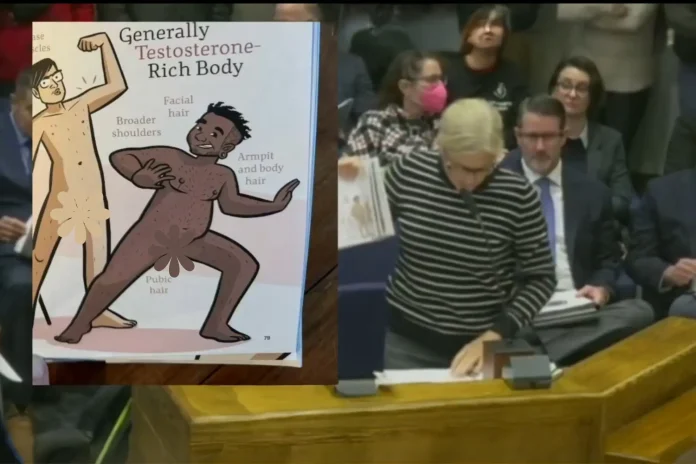
A California mother just forced an entire county boardroom to listen to explicit sex instructions meant for teenagers, and the video is now everywhere. On December 10, 2025, Beth Bourne, a Davis mom and chair of the Yolo County chapter of Moms for Liberty, walked into the Yolo County Board of Supervisors meeting in Woodland carrying blown-up pages from a library book. For three uninterrupted minutes, she read aloud and displayed cartoon drawings of masturbation techniques, anal sex preparation, and teenagers researching BDSM kinks online. Parents across the country are now asking the same questions: What exactly is in this book? How did it end up in a public library that teens can walk into alone? And what should families do next?
The book at the center of the firestorm is Let’s Talk About It: The Teen’s Guide to Sex, Relationships, and Being a Human (2021) by Erika Moen and Matthew Nolan, published by Random House Graphic. It is not a school textbook and has never been assigned in any Yolo County classroom. Instead, copies sit on the young-adult shelves of the county’s public libraries (Woodland, Davis, West Sacramento, and others), where any child with a library card can check it out without age verification or parental permission. The cover and marketing label it “14+,” but in practice, a curious 10- or 11-year-old can easily walk out with it.
Here is precisely what the book shows in full-color comic panels (the same pages Bourne held up at the meeting):
- Full-frontal cartoon nudity of every body type, with close-up labels on vulvas, penises, testicles, and anuses
- Step-by-step illustrated instructions for masturbation, including clitoral stimulation, vaginal fingering, and penile stroking, complete with drawings of fluids and orgasm faces
- Detailed diagrams of vaginal and anal intercourse using condoms and dental dams, plus how to use lube for anal play
- A multi-page section on anal sex preparation: enemas, relaxation techniques, and choosing anal toys
- Advice for teens on researching sexual kinks and fetishes safely online, including which porn sites are “ethical.”
- Conversations between cartoon teens about BDSM, role-playing, spanking, and bondage basics
- Guidance on sexting, including sample nude photos (cartoon) and warnings about revenge porn
The tone is friendly and shame-free, written in a manner similar to a big-sibling chat, which supporters say makes it approachable for confused teens. Critics, including Bourne, say the same tone makes it dangerously attractive to children who are years away from emotional maturity.
How this could affect kids – two sides parents need to hear
Critics’ concerns (shared by many pediatric psychologists and thousands of parents online):
- Younger children who stumble across the images can experience premature sexualization, body anxiety, or confusion about boundaries.
- Explicit “how-to” drawings can plant ideas or pressure before a child is developmentally ready.
- Encouraging solo online research into kinks and pornography can lead straight to unfiltered, exploitative corners of the internet.
- Normalizing polyamory, gender fluidity, and kink culture at a young age may clash with family values and create tension at home.
Defenders’ evidence (cited by Planned Parenthood, the American Library Association, and several teen-health studies):
- Comprehensive, shame-free sex education correlates with later sexual debut, fewer STIs, and lower teen pregnancy rates.
- LGBTQ+ youth who see themselves represented in books report lower rates of depression and suicide ideation.
- Many public schools in California teach little or no sex ed, so accurate library resources can fill a real gap.
What parents can do right now – practical steps
- Check your own library account tonight. Log in to the Yolo County Library catalog (or your local system) and search “Let’s Talk About It.” Check if it’s on the shelf and see if your child has ever checked it out.
- Place a hold or visit in person. Read the book yourself so you know exactly what is there instead of relying on clips or rumors.
- Use the library’s formal reconsideration process. Every public library has a “Request for Reconsideration of Library Materials” form. Filling it out triggers an official review (it worked in several states to move the book to the adult section).
- Adjust your child’s library card settings. Many systems let parents restrict checkout to juvenile materials only. Call your branch and ask.
- Talk to your kids – age-appropriately. Experts on both sides agree: nothing replaces an ongoing, honest conversation at home about bodies, consent, and online safety.
- Attend the next Library Advisory Board meeting. Yolo County Library will discuss this challenge in early 2026; public meetings are the place to make your voice heard calmly and on record.
The county has not announced any immediate removal. Legal counsel reminded the board that First Amendment case law protects library materials unless they meet the legal definition of obscenity for minors – a very high bar that this book has survived in multiple states. Bourne says she and her group are already preparing petitions and possible legal action, building on their $70,000 free-speech settlement win against the county last year.
For families, the deeper issue remains: in an era when any image is one click away, who decides when and how children encounter sexual information – parents at home, or an open library shelf? Whatever side you land on, the events in tiny Yolo County this week just made that question impossible to ignore.
