

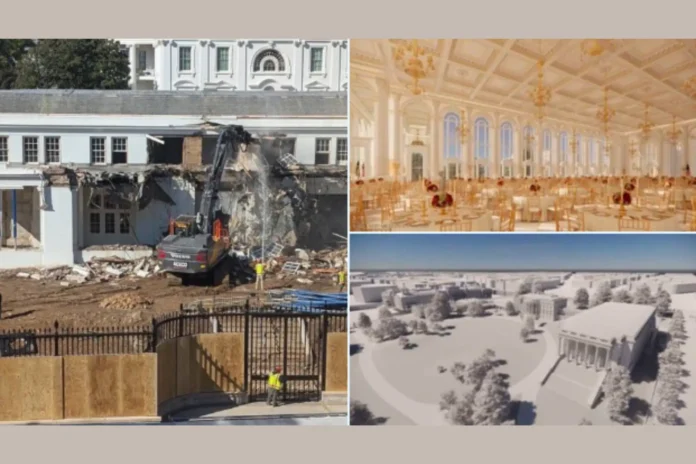
October 20, 2025. Demolition crews have begun tearing down sections of the White House’s East Wing, launching President Donald Trump’s controversial plan to add a grand new ballroom to the historic complex. The project, first announced in July, represents one of the most dramatic physical changes to the White House in decades and is perhaps the most debated.
The new ballroom, approximately 90,000 square feet and projected to cost between $200 million and $250 million, is being paid for entirely with private donations. According to the administration, the money comes from Trump himself and a network of corporate contributors eager to support what the president has described as
“a gift to the American people.”
Designed by McCrery Architects and built by Clark Construction, the project is supposed to respect the White House’s neoclassical style while introducing modern security elements like bulletproof glass and reinforced walls. Renderings show a soaring, chandelier-lit space that can host from 650 to 999 guests with dramatic views toward the Washington Monument. The new building will stand slightly apart from the main residence to avoid direct structural alteration.
A tweet from X.
At a celebratory event on the South Lawn, Trump told supporters,
“They’ve wanted a ballroom for 150 years, and I’m finally giving this wonderful place what it deserves.”
Work began in September, and the administration hopes to complete the project before the end of Trump’s second term in 2029.
The East Wing originally added in 1902 and significantly renovated in 1942 has long housed social offices and support spaces. The current demolition marks the most extensive modification in more than eight decades, according to the White House Historical Association. Officials insist that historic preservation guidelines are being respected, though not everyone is convinced.
Preservationists have voiced sharp criticism. The Society of Architectural Historians called the move “deeply concerning,” warning that the new addition could alter the White House’s character and possibly threaten its National Historic Landmark designation. A former congressman called the project “an utter desecration” due to a failure on the part of any oversight from federal review bodies including but not limited to the Commission of Fine Arts and National Capital Planning Commission both of which have seen operations disrupted by the ongoing partial government shutdown.
The National Park Service, which manages the grounds, acknowledges the president’s broad latitude in matters of federal property but has urged transparency about the project’s private funding sources. To date, the White House has released few details about its donor list or the structure of those financial agreements.
But beyond architectural disputes, the ballroom project has dredged up broader questions of symbolism, priorities, and presidential legacy. Supporters say it’s overdue modernization, a space suited for global diplomacy and for holding major state events. Critics argue it reflects misplaced values in a time when other national needs go unmet.
As historian and preservation advocate Elaine Pruitt told the Associated Press,
“Every administration leaves its mark. The question is whether this one enhances the story of the White House or overwrites it.”

