

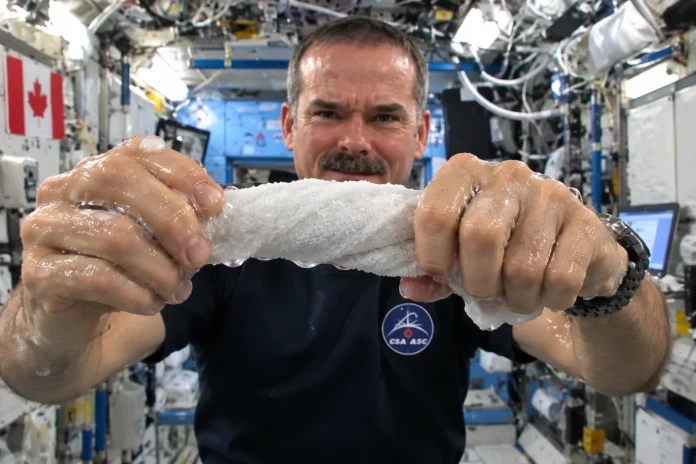
In the weightless environment of the International Space Station, everyday actions can produce surprising results. Canadian astronaut Chris Hadfield demonstrated one of the most memorable examples in 2013 when he soaked a washcloth and wrung it out for a student-designed experiment. Instead of water dripping to the floor as it does on Earth, it clung to the cloth and spread across his hands in a glistening film.
Hadfield, then commander of Expedition 34/35, performed the demonstration after two Grade 10 students from Lockview High School in Fall River, Nova Scotia, won a Canadian Space Agency contest. Kendra Lemke and Meredith Faulkner proposed testing how surface tension would affect a wet washcloth in microgravity. Their hypothesis proved correct.
On the station, washcloths are compressed into dense discs nicknamed “hockey pucks” to save storage space. Hadfield expanded one, then used a sealed bag of drinking water to saturate it thoroughly. Open containers are impractical in orbit because liquids float freely. Once the cloth was soaking wet, he twisted it firmly with both hands.
“It’s really wet. It’s becoming a tube of water,” Hadfield observed as the liquid was forced out of the fabric. The water did not fall away. Instead, surface tension caused it to form a continuous, gel-like coating that ran along the cloth and onto his hands. “The water squeezes out of the cloth and then, because of the surface tension of the water, it actually runs along the surface of the cloth and then up into my hand, almost like you had Jell-O on your hands or gel on your hand and it will just stay there,” he explained. He added that the cloth itself remained relatively compact and floated nearby “like a dog’s chew toy.”
On Earth, gravity pulls free water downward after it is squeezed from fabric. In microgravity, that force is effectively absent. Water molecules remain bound by cohesion (attraction to one another through hydrogen bonds) and surface tension, the tendency of the liquid’s surface to minimize its area. Adhesion also helps the water stick to the cloth fibers and skin. The result is a clinging blob or film rather than falling droplets.
The video, released by the Canadian Space Agency and widely shared by NASA-related channels, has been viewed tens of millions of times. It remains a popular illustration of fluid behavior in space and occasionally resurfaces on social media, including a recent post sharing still images of Hadfield performing the experiment. The demonstration continues to highlight both the scientific principles of surface tension and the practical challenges of managing liquids aboard the space station.
Hadfield’s clear narration and the visually striking outcome turned a simple student question into one of the most engaging educational moments from the ISS.
