

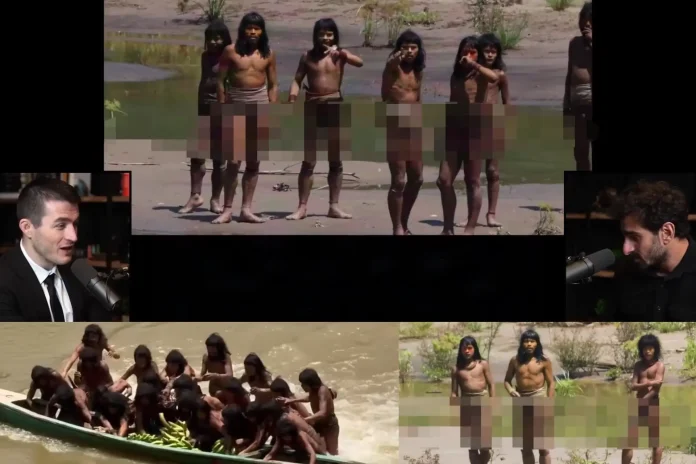
Rare high-definition footage capturing a profound encounter with the Nomole people—widely known as the Mashco Piro, one of the world’s largest remaining uncontacted tribes—debuted this week on the Lex Fridman Podcast, pulling back the veil on a people who have fiercely guarded their isolation for generations. Conservationist Paul Rosolie unveiled the extraordinary video during his January 13, 2026 episode appearance, detailing an October 2024 riverside meeting in the remote Peruvian Amazon where his team shared a tentative, emotionally charged exchange with warriors who emerged from the jungle depths. The clip, already surpassing one million views on YouTube and spreading rapidly across social platforms, offers the clearest documentation yet of their voices, expressions, and fleeting humanity, while igniting urgent conversations about protection amid escalating threats.
The warriors materialize like guardians of an ancient world, stepping gracefully yet warily from the lush emerald canopy onto a sun-dappled muddy beach alive with swirling butterflies and the constant murmur of the river. Lean and powerfully built adult men stand mostly unclothed, their skin adorned with vibrant red and yellow pigments streaking across faces, torsos, and limbs in bold, ritualistic patterns that catch the light like living art. Simple rope cords cinch their waists, with small woven pouches dangling from necks, while impossibly long bows and feathered arrows grip their hands initially in defensive readiness, bodies coiled with instinctive vigilance.
As trust builds, a transformation unfolds before the lens. Weapons lower gently to the sand, postures relax into open stances, and radiant smiles erupt—genuine, unguarded flashes of joy that illuminate stern features and reveal deep humanity. Leaders emerge naturally, gesturing with sweeping arms and pointed fingers toward invisible logging scars on the horizon, their voices rising in urgent choruses, rhythmic claps, and evocative animal calls that echo through the trees.
Hunger soon becomes evident in their hurried movements. When bananas and plantains are offered from the boat, the group surges forward with eager desperation, hands reaching out competitively yet without aggression. Laughter and light dancing follow brief exchanges, with one team member mimicking gestures that the warriors mirror playfully, creating a momentary bridge of shared humanity. In a touching detail, a Junglekeeper’s shirt is tossed across the water, landing proudly over one warrior’s shoulder like a prized upgrade, the logo visible as he wears it with evident satisfaction.
The footage remained private for over a year, released now through Rosolie’s organization, Junglekeepers, to spotlight the growing threats from illegal logging in these protected zones. Experts estimate more than 100 uncontacted groups still exist across the Amazon, many at extreme risk from diseases carried by outsiders, which have devastated similar populations in the past. This calculated debut aims to galvanize international support for expanded patrols and preservation efforts.
The Nómole’s story traces back to profound trauma. At the turn of the 20th century, during Peru’s brutal rubber boom, many were massacred or enslaved by exploitative forces, including a notorious 1894 slaughter linked to baron Carlos Fitzcarrald. Survivors fled deeper into the rainforest, choosing deliberate isolation to escape further violence—a strategy that has preserved their nomadic hunter-gatherer way of life but left them acutely vulnerable today. Recent years have seen forced emergences due to relentless logging incursions, with fatal clashes in 2024 and 2025 claiming lives on both sides and highlighting how territorial overlap breeds tragedy.
They represent just one thread in a vast tapestry of uncontacted peoples across the Amazon. Estimates suggest at least 196 such groups worldwide, with Brazil hosting the highest concentration—dozens roaming vast reserves like the Javari Valley—while Peru alone shelters around 20. Other notable isolated communities include the Kawahiva in Brazil, often sighted fleeing chainsaw noise, and various arrow-wielding groups photographed from afar in protected frontiers spanning Peru, Brazil, and Bolivia. These people face compounding perils from mining, road-building, and missionary incursions, with experts warning half could vanish within a decade absent stronger safeguards.
Social media buzz has intensified since the clip went viral, amassing tens of thousands of views on X and sparking wonder at this historic window into a Stone Age existence. Many commenters plead for absolute non-interference, citing the catastrophic disease risk from even casual contact, while others praise the footage for humanizing a people long mythologized. The release underscores a pivotal dilemma in conservation: such powerful visibility can mobilize aid and deter invaders, yet it risks drawing unwanted attention to those who have survived precisely by remaining unseen.

