

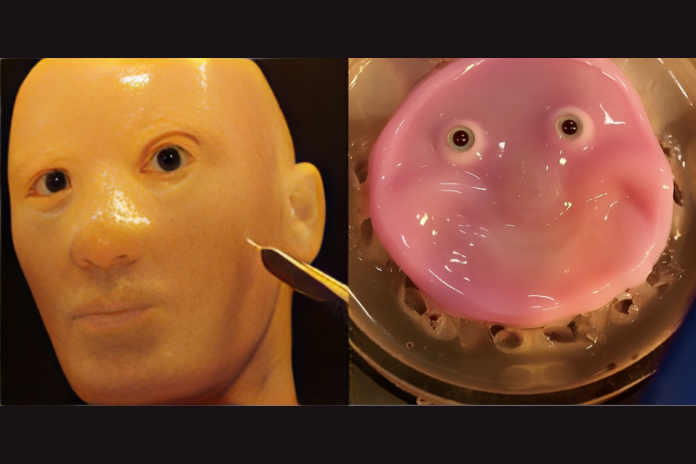
A 47-second clip circulating online is turning heads: a pale pink, fleshy robotic face slowly stretches upward into a wide, unsettling smile. The skin looks soft, moist, and disturbingly real nothing like the rigid silicone masks on most robots. The video, originally from University of Tokyoresearchers, has sparked wild speculation about “human-indistinguishable robots” just around the corner.
In June 2024, Professor Shoji Takeuchi and his team at the Biohybrid Systems Laboratory of the University of Tokyo published their research in the scientific journal Cell Reports Physical Science. They cultured living skin tissue from human dermal fibroblast cells mixed with collagen gel and attached it to a small robotic face mold with a clever new trick: V-shaped holes, inspired by the ligaments that attach real human skin to muscle and bone.
A tweet from X.
The collagen flows into these micro-scale holes during culturing, creating invisible, strong anchors. Tiny actuators underneath then pull the skin to form a realistic cheek-lifting smile and release it back to neutral without tearing. The entire prototype is lab-scale, just a flat facial section, not a full head.
Takeuchi explained the innovation clearly:
“By imitating the structure of human skin and ligaments, and by employing specially prepared V-shape perforations on solid materials, it was possible to adhere skin to complex structures. With the flexibility of the skin and the method of adhesion, it is possible for the skin to move with the mechanical parts of the robot without peeling off or tearing..”
The clip shows exactly that demonstration: skin stretching into a broad grin, holding briefly, then relaxing smoothly. The tissue is biologically alive it can repair minor cuts through cell growth, unlike silicone.
But it’s far from a Hollywood android. There are no eyes, no hair, no blood vessels, no nerves, and no epidermis layer (that’s why it looks raw and pink). The skin must stay in nutrient-rich lab conditions to survive. It has zero consciousness, no AI brain, and no ability to feel or think. Viral claims of “perfect human replicas” are pure hype. This is a proof-of-concept facial skin patch, not a walking, talking robot.
This matters stateside for practical reasons. The technology could slash animal testing in the $500-billion global cosmetics industry by giving companies a living, moving skin model to test products on. It also opens doors for better dermatology research, wound-healing studies, and training plastic surgeons on realistic tissue.
Longer term, self-healing skin coverings could protect medical robots or prosthetics. Takeuchi’s lab has already done similar work on a skin-covered robotic finger that bends naturally.
Plenty of Americans watching the clip feel that familiar “uncanny valley” creep the skin moves like ours, but the missing features make it deeply unsettling. NPR and other outlets noted the eerie effect right away.
Takeuchi himself is realistic about the road ahead.
“In our current research, we were able to replicate human appearance to a certain extent… we also found new challenges, namely, the necessity of surface wrinkles and a thicker epidermis in order to achieve a human appearance,”
He said. Future versions would need sweat glands, pores, blood vessels, fat, and nerves.
He also acknowledges the bigger picture:
“It will be crucial to implement regulatory measures and guidelines to ensure the technology is used responsibly.”
The research stays focused on medical and cosmetic testing, not dystopian android armies.
As of early 2026, this remains a lab prototype with no major new public demos. The science is real, the smile is real but the sci-fi future is still years, if not decades, away. For now, it’s a fascinating step in blending biology with machines, not a reason to panic.

