

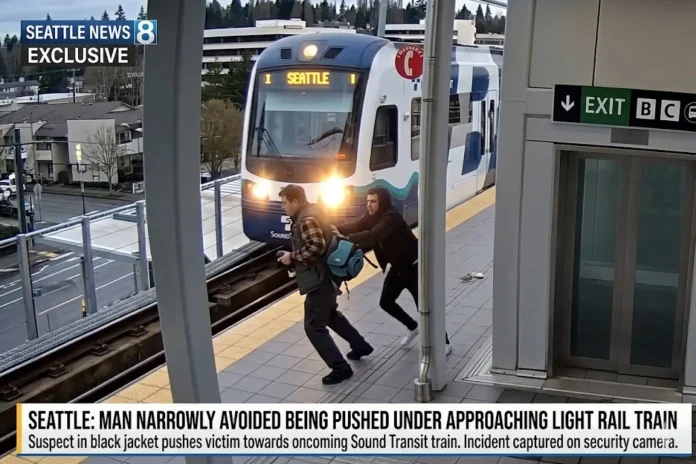
Surveillance video shows the victim standing near the edge looking away when the suspect lunged forward in a calculated move timed with the train’s arrival. The man stumbled into the side of the moving train but regained his balance without falling onto the tracks or sustaining injury. No one else was hurt in the March 19 incident that has since prompted charges of second-degree attempted murder against the attacker.
The suspect Elisio Melendez a 26 year old Seattle resident with a documented history of schizophrenia waited near the platform exit doors before executing the shoves according to charging documents. He fled on foot immediately afterward but was identified through station cameras and arrested five days later at a nearby behavioral health treatment facility where he had been residing. Prosecutors have stated that Melendez deliberately chose the moment to inflict the greatest possible harm on a complete stranger with no prior connection to the victim. The Link light rail system operated by Sound Transit continues to serve thousands of daily riders across the region with the Northgate station acting as a key elevated hub in north Seattle.
Melendez carries a record of prior violence including a 2018 unprovoked assault inside a local church that required the victim to receive stitches and a 2019 stabbing incident involving his sister. Both earlier cases were ultimately dismissed after courts deemed him incompetent to stand trial leading to civil commitment and later release into community based care with housing and psychiatric support. At the time of this latest event he remained under a treatment plan following his discharge from Western State Hospital in early 2022. Details on his full background and prior warrants remain accessible through public records maintained by the King County Superior Court.
Melendez is currently held in custody on 750000 dollars bail while a court ordered mental health evaluation proceeds. The victim whose identity has not been released has not come forward with additional public statements leaving the focus on the legal proceedings and station security measures. This case arrives amid broader discussions in Washington state about how best to manage severe mental illness in community settings to protect both individuals in care and the general public. The Washington State Department of Social and Health Services outlines policies on behavioral health services that emphasize less restrictive environments whenever possible yet incidents like this raise practical questions about oversight and intervention thresholds.
Public transit systems in major cities face persistent pressure to balance accessibility with safety especially when individuals with untreated or recurring conditions interact with everyday commuters. This event underscores gaps in the current framework for monitoring high risk cases after release from structured facilities where repeat behaviors have already been documented. Stronger coordination between mental health providers law enforcement and transit authorities could help close those gaps without compromising care standards or individual rights. As the case moves forward through the courts it serves as a reminder that prevention requires sustained resources and clear accountability to keep platforms safe for all riders.

