

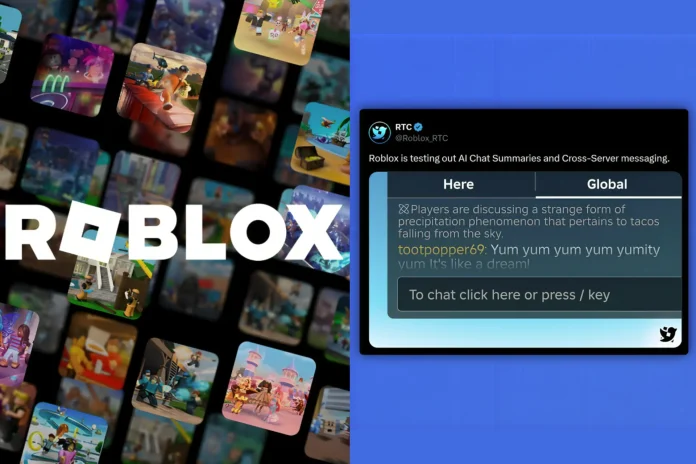
Roblox is rolling out AI-generated chat summaries that replace blocked messages between players in different age groups. To countless young Americans, their parents, and gamers, this translates to less irritation with locks and dots on chat but more curiosity on how AI deals with kids’ safety on one of the world’s largest online platforms.
In late April 2026, Roblox began an initial testing phase of its innovative Chat Summaries feature, with selected users receiving the update in rapid succession. Rather than getting locks or dots when interacting with other users in various age groups, players will receive a summary, powered by high-end AI technology, identified by the AI symbol.
“Instead of seeing locks and dots when chatting across different age groups, users will now see safe, high-level auto generated summaries… It’s about keeping everyone in the loop without compromising on safety,”
according to the official Roblox Developer Forum announcement.
A simple example from testing: When players discuss something fun like “taco rain” in a game, the AI might summarize it as a light discussion about the event, letting others get the vibe without seeing the exact words from restricted age groups.
A tweet from X.
This pairs with new “Here” and “Global” chat tabs for cross-server chatting within the same age, language, and location groups.
Roblox has faced years of criticism in the U.S. over child safety, grooming risks, and moderation issues. The platform, with tens of millions of daily users including many under 13, introduced mandatory age checks for chat in early 2026.
Users complete a quick facial age estimation via their device’s camera (images are deleted immediately after processing) or optional ID verification. This assigns them to brackets like Under 9, 9–12, 13–15, 16–17, 18–20, or 21+.
Chat is limited mostly to your own group and adjacent ones. For under 9s, it’s off by default unless parents consent. The old blocking system often broke gameplay flow in team-based or social experiences.
The AI creates concise, high-level overviews in real time. Summaries run through Roblox’s existing text filters, and any violative content stays blocked entirely no summary appears.
All users, even those who haven’t age-checked yet, can see the summaries to follow the chat. But you still need to complete age verification to send your own messages.
Users can opt out in some testing phases, and Roblox plans a toggle for having your messages included in summaries. The feature is system-generated and currently has no per-game disable option.
It builds on earlier AI tools, like real-time rephrasing for profanity in allowed chats.
Reactions are mixed. Some players and developers welcome the change as a quality-of-life win.
One dev forum user noted it helps in interactive games: instead of guessing via emotes, you can understand coordination questions like someone asking about finding the bathroom.
Others raise concerns about AI accuracy summaries might be too vague or miss nuance plus privacy worries since the AI still processes messages. Some call it unnecessary AI involvement, and parents question whether it fully solves moderation problems or could indirectly expose kids to off-tone contexts.
Roblox has responded to feedback by promising more documentation and tuning based on tests.
This update reflects Roblox’s push to balance safety with fun after heavy U.S. scrutiny and lawsuits around child protection. By using AI to mediate cross-age chat instead of total blocks, the company aims to keep gameplay immersive while enforcing strict age limits.
For American families, it highlights the growing role of AI and biometrics in online platforms used by kids. As testing continues and features like stricter “Roblox Kids” and “Roblox Select” accounts roll out around June 2026, the bigger test will be whether these tools deliver real safety without killing the social energy that makes Roblox popular.
The future of social gaming may increasingly rely on AI as an invisible moderator translating conversations across barriers while trying to protect the youngest users. How well it works will shape trust for millions of players and parents in the months ahead.

