

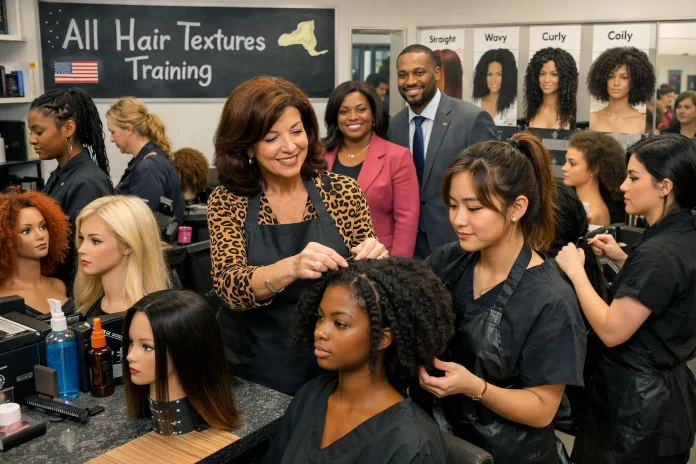
Starting this fall, aspiring cosmetologists and natural hair stylists in New York will be required to receive hands-on training in caring for all hair textures — including kinky, coily, curly, wavy, wiry and straight — as part of their state-approved education.
The New York Department of State published proposed rule changes in the state register in March 2026, outlining updates to school curricula that stem from Bill S6528A. Governor Kathy Hochul signed the legislation in November 2023, with co-authors Assemblywoman Michaelle Solages and Senator Jamaal Bailey. The measure aims to address longstanding industry complaints that some stylists refuse service to clients with textured hair or mishandle it, leading to damage and, in some cases, discrimination claims — including a high-profile lawsuit involving an Ulta Beauty salon.
The changes take effect for new students entering programs on or after Sept. 1, 2026. Schools must submit updated curricula for approval and incorporate diverse training tools, such as mannequins representing various hair textures. Non-compliant programs risk disciplinary action or fines. Currently licensed stylists will face no additional requirements for license renewal.
The total hours for licensure remain unchanged: cosmetology programs typically require 1,000 hours, while the more specialized natural hair styling license calls for 300 hours focused on braiding, weaving, locking and non-chemical services. The new content is woven into existing subjects rather than added as entirely separate blocks.
Key additions include expanded instruction in hair analysis (covering structure, growth cycles, porosity, elasticity and all textures, with explicit mention of fine/medium/thick strands and straight through Afro/kinky types), shampoos/conditioners/treatments with an emphasis on hydration, moisture retention and detangling for coily and curly hair, and styling techniques such as twist-outs, Bantu knots, flexi-rods, diffusing, braiding/weaving and preventing heat damage on natural hair. These elements are integrated into broader areas like hair cutting, chemical services and client consultation, with corresponding updates to the state board exam’s written and practical portions.
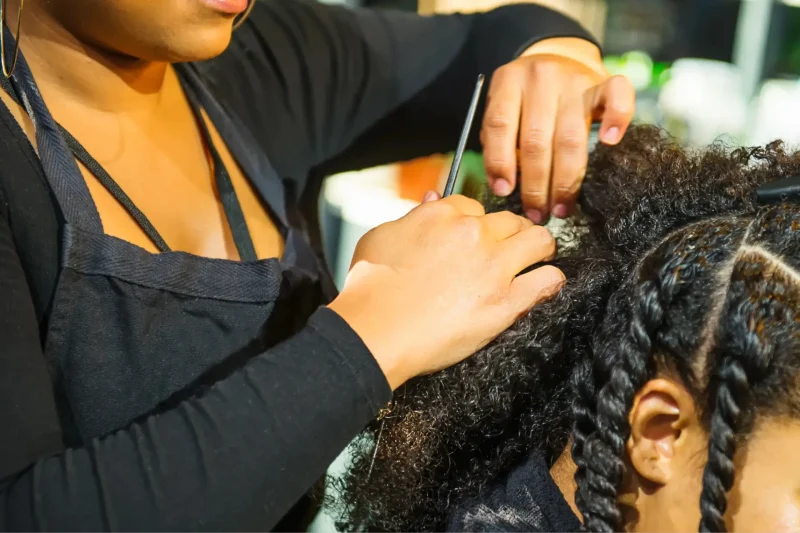
The law responds to reports that many training programs historically emphasized straight hair techniques, leaving gaps in competence for textured hair — particularly Type 3 and 4 curls and coils, which often require different approaches to moisture, detangling and shrinkage management. Proponents note that while experienced stylists have long adapted through specialization and market demand, standardizing foundational knowledge ensures all future licensees can serve clients professionally without defaulting to the familiar excuse of “we don’t do that hair type.”
Similar textured hair education initiatives have emerged in other states and through advocacy efforts focused on practical hair science. The focus here remains technical: understanding how porosity, elasticity, density and pH affect product and tool performance across textures.
Schools now have several months to revise lesson plans, acquire appropriate tools and products (such as wide-tooth combs and diffusers), and prepare instructors before submitting materials for state review. Full details of the proposed regulations, including curriculum outlines under the state’s Appearance Enhancement rules, are available via the New York Department of State website.
The move is expected to make salons more inclusive overall, though deeper expertise in natural hair will continue to be driven by experience, client demand and optional advanced training. As the beauty industry evolves, this requirement positions New York to close a noticeable educational gap for the next generation of licensed professionals.
