

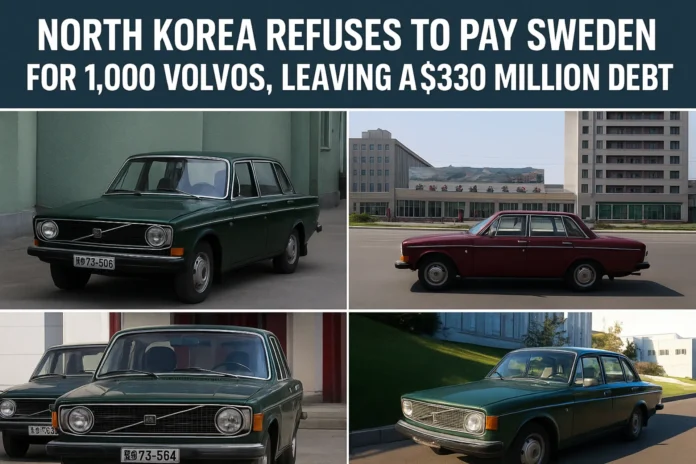
North Korea’s refusal to pay Sweden for 1,000 Volvo cars, now a $330 million debt, remains one of the boldest unpaid bills in history, with Sweden politely sending reminders every six months. This peculiar saga, often called the “largest car theft in human history,” began in the 1970s and continues to shape the unique diplomatic ties between these two nations. In the early 1970s, North Korea sought to modernize its economy and saw Sweden as a key trade partner. Swedish companies, including Volvo, showcased their products in Pyongyang, leading to a 1974 deal for 1,000 Volvo 144 sedans, valued at about $70 million.
North Korea promised payment but never delivered, leaving Sweden with a growing debt that, with interest, has ballooned to an estimated $330 million by 2025. The Swedish Export Credit Agency, which insured the deal, covered Volvo’s losses, but the government still seeks repayment, sending biannual reminders that North Korea consistently ignores. Despite the financial dispute, Sweden and North Korea share a surprisingly close diplomatic relationship. Established on April 7, 1973, Sweden was the first Western European nation to form ties with North Korea.
During the Korean War (1950-1953), Sweden contributed through the Swedish Red Cross and joined the Neutral Nations Supervisory Commission, building trust as a neutral player. In 1975, Sweden opened the first Western embassy in Pyongyang, a role it still holds, representing countries like the United States and Canada, which lack formal ties with North Korea. The unpaid Volvos have become a symbol of this complex relationship. Many of the durable cars are still in use in North Korea, often as taxis, with some clocking nearly 500,000 kilometers.
The Swedish Embassy once tweeted about spotting a Volvo taxi in 2016, highlighting both the car’s longevity and the unresolved debt. This lighthearted approach contrasts with Sweden’s serious diplomatic role, such as facilitating talks for the 2018 North Korea-U.S. summit. Sweden’s persistence reflects its broader strategy of maintaining open channels with North Korea.
Beyond the debt, Sweden provides humanitarian aid and acts as a mediator, leveraging its neutral status to foster dialogue. The biannual reminders, while symbolic, keep the issue alive without derailing diplomatic efforts. The Volvo debt story continues to capture global attention, popping up on social media and sparking curiosity about North Korea’s economic practices. With no sign of repayment, Sweden’s patient approach underscores its commitment to diplomacy over confrontation.

