

What if the edge you need to dominate the field begins not with a warm-up drill, but with the subtle flex of foam under your feet?
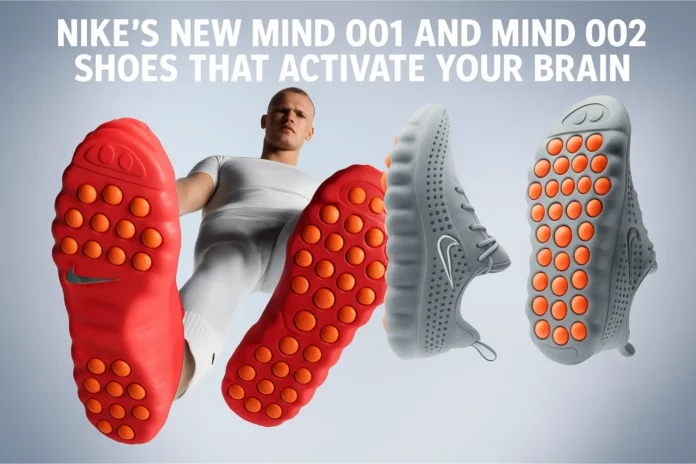
Nike just unveiled the Mind 001 mule and Mind 002 sneaker, a pair of groundbreaking shoes engineered to sharpen an athlete’s mental state right before the action starts. Drawing from years of neuroscience research, these designs embed 22 independent orange foam nodes in the soles to deliver targeted sensory feedback that travels straight to the brain’s focus centers. The result? A heightened sense of presence and calm that could redefine pre-game rituals for pros and everyday competitors alike.
The Mind 001 serves as a sleek slip-on mule, perfect for quick recovery sessions or light warm-ups, with breathable perforated fabrics and a molded heel for easy entry. Its counterpart, the Mind 002, steps up as a laced sneaker built for more dynamic movement, securing the foot to amplify that ground-level connection during strides. Both models share a minimalist look in neutral tones like light smoke grey and black with crimson accents, ensuring they blend into any locker room vibe while prioritizing function over flash.
At the heart of this innovation lies the Nike Mind Platform, the brand’s inaugural foray into neuroscience-driven footwear. Each node acts like a tiny piston, compressing and shifting on impact to mimic uneven terrain and send precise vibrations to the foot’s mechanoreceptors. This input zips up neural pathways to the somatosensory cortex, ramping up alpha waves for a state of relaxed alertness and quieting the mind’s wandering tendencies. Early tests revealed shifts in brain activity within minutes, turning a simple walk into a mental reset button.
This isn’t a shot in the dark; it builds on a decade of work in Nike’s Sport Research Lab, where scientists pored over EEG scans and muscle signals from more than 2,000 athletes. Key figures like Principal Neuroscientist Graeme Moffat guided the node placements based on perceptual hotspots, while sensory expert Trevor Barss fine-tuned the tactile patterns. The lab’s mobile imaging setup captured real-time data during motion, proving the nodes spark measurable engagement in sensory brain regions without overwhelming the wearer.
Athletes already sense the difference. Manchester City striker Erling Haaland, who tested prototypes over five years, shared how the shoes ground him:
“Every step I take, I think of the shoe and what I feel in my feet, which is a good thing. It helps me to bring balance to my game.”
That kind of endorsement from a goal machine like Haaland highlights the potential for everyday training gains, from steadier footwork to quicker decision-making under lights.
The perks extend beyond the pitch. Users report deeper concentration that cuts through distractions, a surge in body awareness for intuitive balance, and even subtle boosts in resilience during high-stakes moments. Internal studies clocked over 100,000 hours of wear, linking the tech to clearer heads and potentially stronger outputs, though individual results will hinge on personal wiring.
Priced accessibly at $95 for the Mind 001 and $145 for the Mind 002, these drop in January 2026 via Nike’s site and select retailers, with sizes spanning men’s and women’s adult ranges. It’s a smart entry point for a tech that could evolve into broader wellness gear.
From my vantage covering the pulse of sports innovation, Nike’s bet on brain-foot synergy feels like a natural pivot in an era where mental toughness often seals the win. It echoes broader findings on how targeted physical cues can rewire neural efficiency for better performance, as detailed in this review of exercise’s role in brain adaptability.
Yet, for all its promise, the platform awaits independent scrutiny to iron out variables like varying foot sensitivities or long-term wear effects. True breakthroughs demand that balance between hype and hard proof, and Nike seems poised to deliver more data as adoption grows.
