

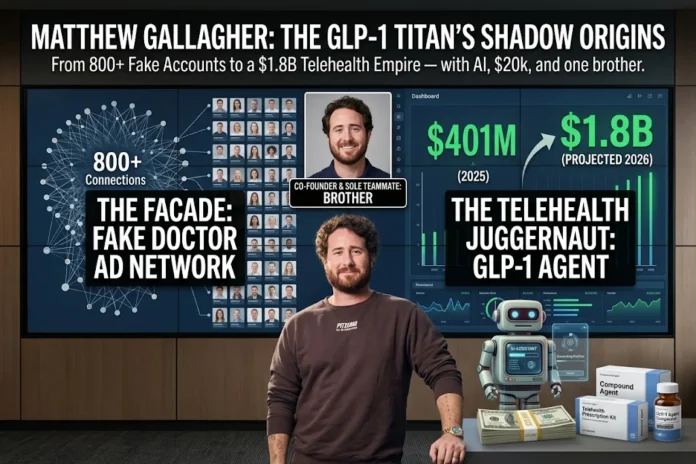
Matthew Gallagher created more than eight hundred Facebook accounts impersonating doctors to advertise compounded weight-loss injections and then turned that marketing engine into Medvi, a telehealth company that generated four hundred one million dollars in revenue in two thousand twenty five using only twenty thousand dollars in startup capital, artificial intelligence tools, and his brother as the single full-time employee.
The Los Angeles-based platform gave patients fast online access to prescriptions for semaglutide and tirzepatide without requiring office visits. It later added men’s health treatments, meal delivery, and skincare. Gallagher launched the site in September two thousand twenty four after roughly two months of development. He and his brother Elliot handled every non-clinical function while licensed partners managed prescriptions and shipping. The lean operation reached two hundred fifty thousand customers and delivered sixty five million dollars in net profit, a sixteen point two percent margin that produced a daily run rate exceeding three million dollars heading into two thousand twenty six.
Gallagher relied on more than a dozen artificial intelligence systems to build and run the business. He used ChatGPT, Claude, and Grok to generate the website code and backend systems. Midjourney and Runway created the advertising visuals and video assets. ElevenLabs produced voiceovers for customer communications. Custom AI agents connected the different tools while a chatbot fielded service inquiries. This approach let a two-person team replicate functions that typically require dozens of employees in traditional telehealth startups. Industry observers note that similar AI-driven automation is becoming common as founders seek to compete in the high-customer-acquisition-cost weight-loss market without venture capital.
The initial growth strategy that powered Medvi now sits at the center of a broader regulatory storm. The FDA declared the national shortages of semaglutide and tirzepatide officially resolved by early two thousand twenty-five. Compounding pharmacies lost the temporary exemption that had allowed them to produce large volumes of these drugs. Federal rules now restrict compounded versions to patients with documented medical needs such as allergies to inactive ingredients in the brand-name products. On February sixth two thousand twenty-six the agency announced it would restrict mass-marketed compounded GLP-1 active ingredients and pursue enforcement against companies making misleading claims. Medvi received its own formal warning letter on February twentieth for misbranding compounded semaglutide and tirzepatide on its website. Regulators cited false implications that the company itself compounded the medications and that the products matched FDA-approved versions in safety and efficacy.
These actions fit a pattern of heightened scrutiny across the sector. In March two thousand twenty six the FDA issued warning letters to thirty telehealth companies for similar marketing violations. The agency emphasized that compounded drugs have not undergone the same safety, effectiveness, or quality review as branded GLP-1 medications. Telehealth prescribing flexibilities for controlled substances remain extended through the end of two thousand twenty six under a fourth temporary DEA and HHS rule, but GLP-1 drugs are not controlled substances and fall under separate FDA compounding and advertising rules. A class-action lawsuit filed in Delaware in November two thousand twenty five against Medvi and its fulfillment partners further underscores customer concerns about product claims and outcomes.
Gallagher’s background adds context to the rapid rise. The forty-one-year-old grew up in a trailer park, taught himself to code, and previously ran Watch Gang, a watch-subscription service. He dropped out of the University of Cincinnati and worked in insurance customer service and freelance programming before applying the same bootstrapped mindset to Medvi. The company operates without outside investors and maintains one hundred percent ownership. Verified financial details place it on track for one point eight billion dollars in revenue this year. The original advertising tactic surfaced publicly in a widely shared social media post that included screenshots of the fake-doctor profiles still active in the Facebook Ads Library as recently as March two thousand twenty six.
This case illustrates both the promise and the pitfalls of artificial intelligence in telehealth. Tools that once required engineering teams can now let solo founders prototype platforms and scale advertising in weeks instead of years. Yet the same speed that enabled Medvi’s growth also compressed the time available for regulatory compliance. As the FDA tightens rules on compounded GLP-1 marketing and telehealth companies face increased enforcement, the industry must reconcile rapid innovation with patient safety standards. The outcome for Medvi and similar lean startups will help determine whether artificial intelligence truly democratizes health care or simply accelerates the regulatory pushback that follows unchecked scaling.

