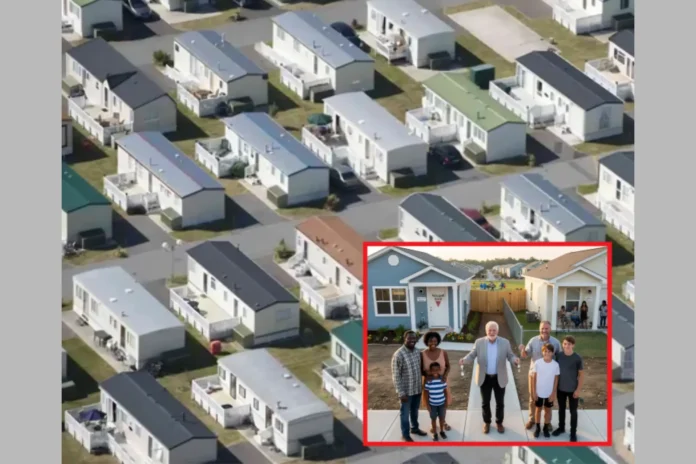
Petra Hanes used to sleep under bridges and considered ending it all. Six years of homelessness had taken everything. Today she runs her own art business from a bright blue tiny home, sells prints in the community café, and pays rent from money she earns herself.
Her neighbour, a former welder who lost his licence to addiction, now leads the construction crew that builds the next wave of homes. Another resident, once on the provincial “By-Name List” of the chronically homeless, works the early shift at Neighbourly Coffee and has not touched social assistance in 18 months.
A tweet from X.
These are not feel-good anecdotes. They are the day-to-day reality at 12 Neighbours, the nonprofit village started by Canadian tech entrepreneur Marcel LeBrun.
LeBrun sold his social-media monitoring company, Radian6, to Salesforce in 2011 for roughly $340 million. Instead of buying islands or sports cars, he put more than $13 million of his own money into a 60-acre patch of land on Fredericton’s north side. There, on a former Christmas-tree farm next to a Walmart, he built 99 colourful tiny homes each 250 square feet, with a full kitchen, bathroom, sleeping loft, deck and solar panels.
The last home was craned into place in April 2024. By mid-2025 more than 100 formerly homeless men and women called the village home.
Rents start around $200 a month, capped at 30 per cent of whatever income a resident has. People move in straight from tents, shelters or the street, chosen from the city’s prioritised By-Name List.
But the real difference is what happens after move-in day.
A gleaming Enterprise Centre sits at the heart of the village. Inside, residents train as baristas, bakers and screen-printers. Some join the paid construction crew that builds more tiny homes either for the village itself or for sale to order. Others have launched small businesses. One man started a woodworking shop; Petra sells her artwork under the name “Art by Petra.”
“Housing is the start community is the healing agent,”
LeBrun says. He calls the advantages he was born into stable family, good schools, being in the right place at the right time “lottery wins.”
“I won the lottery several times over,”
he told hypefresh in 2024.
“I feel a responsibility to give others a ticket.”
The village is not perfect. Early on, staff had to set firm boundaries when old street associates showed up looking for drugs or handouts. Some neighbours worried about having so many formerly homeless people in one place. LeBrun answers that scattered supportive housing is ideal, but when people are dying on the streets you build what you can, as fast as you can.
“It’s not charity,”
He says.
“It’s about helping people flourish in their talents.”
In 2025 the model is spreading. LeBrun’s new “Neighbourly Homes” units smaller, courtyard-style clusters can be dropped onto vacant lots in a single day at about $7,500 each. The first sanctioned sites opened in Saint John, with more planned for Miramichi, complete with a hobby farm. Councillors from Peterborough, Ontario, visited in August to see if the idea could work there.
When a video of colourful tiny homes and captions about a “millionaire who fixed homelessness” blows up on social media, it’s natural to wonder if it’s real. Here’s a quick way to separate truth from exaggeration
Across the English-speaking world Britain, Australia, the United States, even here in Canada politicians and charities are running out of answers to visible homelessness. Emergency shelters cost taxpayers dearly and rarely lead to permanent exits. Wait-lists for subsidised housing stretch years.
What Fredericton now has is something rarer a private citizen who used entrepreneurial speed and private capital to prove a different path is possible one rooted in dignity, work and belonging.
LeBrun is the first to say one village, or even ten, will not “solve” homelessness. But on a quiet evening, when the bakery smells drift across the green and residents sit on their decks waving to neighbours they now call friends, it is hard to argue the model is not working.
And for the first time in a long time, people like Petra Hanes are not just surviving. They are building a life.