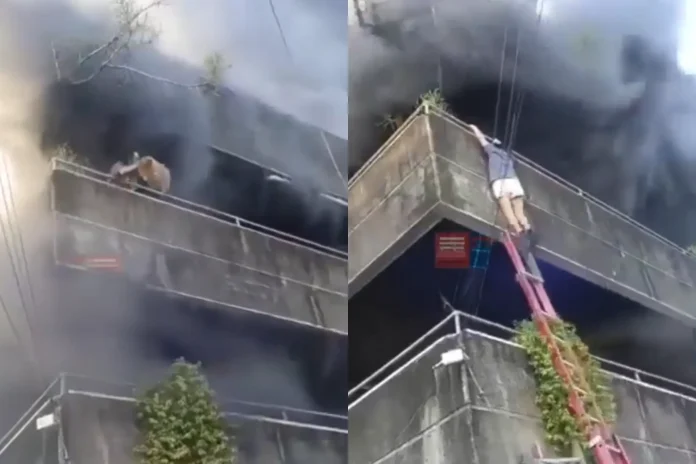
Smoke so black it swallowed the dawn poured from the styrofoam factory in Barangay Guizo, Mandaue City, just before seven on Wednesday morning. What began as a small pop of electricity inside the warehouse turned into a roaring furnace within minutes, the mountain of white foam blocks melting into rivers of liquid fire that hissed and spat like a living thing. Flames leapt twenty, thirty feet into the air, licking the side of the four-storey residential building next door as if tasting it before deciding to devour.
On the third-floor balcony, thirty-something Eimeilee Maningo felt the heat slap her face while the screams from the street rose in pitch. The stairwell below her had already become a chimney of fire and poison. There was no way down except straight through hell, and she was not leaving alone. Her two small dogs — one cream-colored shih tzu mix named Mochi, the other a scrappy black-and-tan rescue called Coffee — pressed trembling against her legs, coughing in tiny, panicked bursts.
She scooped Mochi first. The balcony railing was scorching to the touch. Ten, maybe twelve feet below, neighbors had formed a ragged circle of outstretched arms, some on tiptoes, others already on each other’s shoulders. The smoke was so thick now that she could barely see them through the stinging haze. She kissed the top of Mochi’s head, whispered “Mama loves you,” and let the dog drop. A collective gasp, then a cheer — Mochi landed safely in a neighbor’s blanket, legs scrambling, unhurt. Coffee whined and pawed at her thigh, sensing he was next.
The second drop was harder. Coffee was heavier and terrified, twisting in her grip. A tongue of flame curled up the wall behind her; the plastic gutter above her head began dripping molten drops that sizzled on the concrete floor. Eimeilee leaned as far over the railing as she dared, arms shaking, until strong hands below shouted they had him. She let go. Coffee yelped once on the way down and landed with a soft thud into waiting arms. The crowd erupted again, louder this time, because everyone understood what they had just witnessed: she had used the very last seconds of breathable air to save the only family she refused to lose.
Only then did she turn to face the fire that now owned her apartment. The living-room curtains were already gone, replaced by a wall of orange. She pressed her sleeve over her mouth, coughing so hard her ribs hurt, and realized the balcony itself was starting to buckle. That was when the ladder from the Mandaue City Fire Station truck finally clanged against the railing. Two firefighters in sweat-streaked gear reached for her, hauling her onto the rungs as the balcony floor behind her gave a sickening crack and partially collapsed.
She made it to the ground barefoot, lungs raw, hair singed at the ends, but alive. Mochi and Coffee barreled into her legs the instant her feet touched asphalt, tails wagging so hard their whole bodies shook. A paramedic wrapped a blanket around her shoulders and slipped an oxygen mask over her face while neighbors pressed close, some crying, some filming, all repeating the same word: bayani (hero).
By 10 a.m., the fire was out, leaving behind a blackened skeleton of twisted metal and the sharp, chemical stench of burned Styrofoam that clung to clothes and skin for days. Damage topped ten million pesos. Eimeilee’s apartment and everything in it — photos, clothes, the little savings hidden in a biscuit tin — turned to ash. Yet when a local reporter asked what hurt the most to lose, she looked down at the two muddy, smoke-smudged dogs curled against her and answered without hesitation: “Nothing. I still have them.”
Hours later, the 101-second video shot by neighbor Ivy Baya went viral, exploding across Facebook and X. By nightfall, #FurMomHero had become a nationwide trend. Strangers sent pet food, blankets, and cash donations. The Mandaue City Social Welfare and Development Office set up a temporary shelter for the twenty-three displaced families. Still, Eimeilee spent the first night on a friend’s couch with Mochi and Coffee snoring on either side of her, their warmth the only familiar thing left in the world.
The Bureau of Fire Protection’s initial report points to faulty wiring inside the factory, the same everyday danger that has sparked four major blazes in Mandaue this year alone. Each time, the story is the same: industrial zones are pressed too close to homes, flammable materials are stored without enough caution, and families pay the price.
Eimeilee’s choice to risk everything for two small dogs has become the rare bright line in a year of too many dark ones. In the quiet that follows disaster, one truth stands out clearer than the smoke ever did: when the world is burning, some people will still reach back into the flames for the ones who cannot save themselves. Eimeilee Maningo did precisely that and walked out carrying love instead of loss.