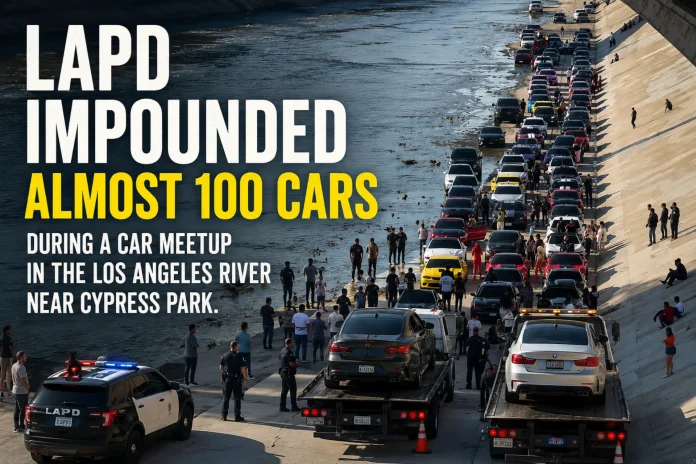
Los Angeles police impounded 72 vehicles and cited nearly 90 people after more than 100 cars and motorcycles converged in the concrete flood control channel of the Los Angeles River near Cypress Park, a neighborhood on the river’s east bank in northeast Los Angeles, on June 7, 2026, according to Fox LA’s coverage of the Cypress Park impound. Drivers had gathered there for what they called a peaceful photo opportunity with the downtown skyline providing a striking backdrop. Many had promoted the event online as a casual photography session where enthusiasts could showcase their vehicles in a scenic urban setting without the usual distractions of city streets.
They gathered there because the spot offered a unique urban setting that car culture enthusiasts find appealing for capturing high-quality images of their modified sports cars and motorcycles without the interference of typical street traffic. Participants like motorcycle owner Alexander Pimienta and Ford Mustang owner Angel Rodriguez later shared that the location seemed ideal for a low-key meetup with friends who share a passion for automobiles. Yet the concrete channel, while visually striking, is designated strictly for flood control and remains off-limits to unauthorized vehicle access.
The drivers broke trespassing laws by entering the restricted no-entry zones of the flood control channel, which is managed to protect critical infrastructure. Police from the LAPD Street Racing Task Force, an LAPD unit formed to combat illegal street racing, sideshows, and unauthorized takeovers of public roadways, intervened around 6 p.m. because the gathering violated posted access restrictions and fit into the department’s broader mission to prevent unauthorized use of public spaces that might encourage unsafe activities. Officers blocked the exits, issued citations, and coordinated with tow trucks to clear the area methodically as the sun began to set over the riverbed. The intervention fits a wider pattern of high-profile Los Angeles police actions, similar to the LAPD’s recent Northridge investigation into a fatal parked-car shooting.
The impounded cars will remain in storage at an official facility until their owners pay substantial towing and storage fees that can exceed three thousand dollars per vehicle along with any mandatory 30-day hold periods. Most owners received misdemeanor trespassing citations, while two individuals faced felony arrests, and all will need to resolve these legal matters before they can reclaim their property. For car enthusiasts like Alexander Pimienta, whose motorcycle was seized, and Angel Rodriguez, whose Ford Mustang was taken, this outcome means unexpected expenses and time away from their beloved rides, turning a fun afternoon into a costly ordeal. The same network of impound lots that took in the Cypress Park vehicles has also handled other high-profile cases, including an LAPD discovery of a body inside a Tesla at a Hollywood tow yard.
Attendees have described feeling caught off guard by the enforcement, noting that the trespassing signs were small and hard to spot while driving into the channel. This perspective humanizes the event, showing how passion for car culture can sometimes overlook regulatory details in the pursuit of memorable moments with friends. The financial and legal burdens now facing these individuals underscore the real-world consequences that follow even well-intentioned gatherings in regulated areas.
The river channel itself serves as critical flood control infrastructure managed by county officials who prohibit vehicle access to prevent damage and ensure emergency responsiveness during storms. Drivers had promoted the meet online as a casual photography session, yet the location sits squarely within posted no-entry zones designed to safeguard both the public and the concrete infrastructure. Enforcement in this case aligned with broader city priorities to deter unauthorized use of public spaces that could escalate into hazards for participants or nearby residents.
Owners now face the practical fallout of retrieving their cars from storage, where fees for towing, storage, and release can quickly climb past three thousand dollars per vehicle in addition to any mandatory 30-day hold periods. The Official Police Garage, the city-contracted operator that stores vehicles impounded by LAPD, lists its towing and storage rates outlining the exact costs that must be settled before vehicles can be reclaimed, underscoring the financial burden on enthusiasts who viewed the outing as harmless. Many in the local car community expressed frustration online, arguing that the response overlooked the cultural value of such meets, while others pointed to the need for clearer boundaries in popular but regulated areas. For some owners, sudden vehicle losses carry a personal weight that goes well beyond dollars and cents, much like the case of a Japanese music producer whose dream Ferrari burst into flames an hour after a 10-year wait.
This episode underscores the persistent challenge of balancing vibrant automotive enthusiasm with public safety regulations in a city known for its car culture. The Los Angeles County Department of Public Works flood control information and its official river signage guidelines emphasize that the channel remains closed to vehicles for good reason, yet events like this reveal gaps in how those rules reach everyday drivers. At the same time, the LAPD Street Racing Task Force operations reflect a sustained commitment to preventing activities that have historically led to injuries and property damage across Southern California neighborhoods.
For the affected drivers, the impoundments represent more than lost time and money; they highlight how quickly a planned gathering can shift from celebration to confrontation when regulatory lines are crossed, even unintentionally. City leaders may need to consider improved outreach or designated spaces for car photography to reduce future conflicts while still upholding the core mission of flood protection and orderly public spaces. In the end, the incident serves as a reminder that passion for vehicles thrives best when it respects the infrastructure built to keep communities safe.