Dallas Mavericks guard Kyrie Irving surprised fans in August 2025 when he announced his plan to become “one of the biggest farmers ever.” During a Twitch livestream and later on the Road Trippin’ podcast, the eight-time NBA All-Star shared his vision of reshaping food access, wellness, and community living through large-scale farming.
“Healthy life is the best life,”
Irving said.
“I know being healthy is expensive nowadays and inflation and things of that nature, but I’m building towards becoming one of the biggest farmers ever. I’m just going to put it out there.”
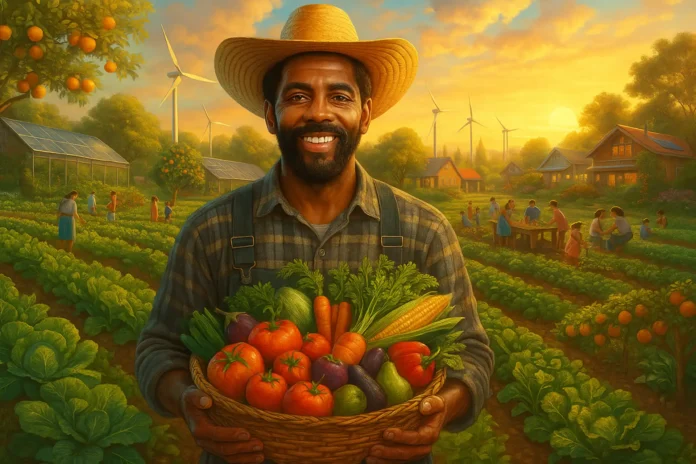
For Irving, it is about business plus sustainability, self-reliance, and wholistic living. His vision is to develop the creation of “wellness villages” where families would be able to prosper, comfortably give birth, and be living in balance with the earth.
The driving force behind Irving is the conviction that “health is the best wealth.” His mission is to provide nutritious food affordably while cutting down expenses for households struggling with escalating grocery bills.
“I’d rather know how to grow food than put a basketball in a hoop and that’s the only thing I know how to do,”
He explained.
“I’d much rather learn how to tend to a garden and be fruitful off the land and that’s the real wealth.”
This initiative is an extension of his longstanding interests in sustainability. Working through the KAI Family Foundation, the water-security-enhancing initiatives it funded include a solar-powered water facility to cover drought-prone regions of Pakistan. His farming ambitions seem an organic extension of the self-reliance push of the KAI Family Foundation.
A tweet from X.
Irving is actively seeking farmers and agricultural experts in New Jersey, Los Angeles, and Texas to help him gain hands-on knowledge about growing food sustainably. While his vision is global, he’s starting local engaging with small farmers, regenerative agriculture specialists, and wellness advocates.
During the livestream, he even stated the possibility of exploring latest farming technologies, such as climate-smart farming methods and possible weather adaptation mechanisms. Nonetheless, there was no confirmation on official filings, business registrations, or land acquisition up to August 2025.
It makes one wonder about scale. A typical U.S. farm covers an average of 466 acres, the USDA reports. By comparison, Bill Gates is the largest private farmland owner in the country, holding approximately 270,000 acres a figure that represents only 0.03% of total U.S. farmland.
Globally, some mega-farms, such as China’s Mudanjiang dairy complex, operate on millions of acres. To reach even a fraction of that scale, Irving would need substantial capital, strategic partnerships, and years of expertise.
Fans and contemporaries have reacted with both encouragement and good-natured humor. Ex-NBA player Kendrick Perkins tweeted he’d
“teach Kyrie how to kill a chicken in 30 minutes,”
And Road Trippin’ host Channing Frye welcomed the move toward environmentally friendly living.
But others challenge his lack of farming experience and the viability of large-scale growth of a global farming business. Others draw the announcement into Irving’s larger trend of unusual diversions, ranging from previous COVID-19 vaccine controversies to contentious statements on social topics.
Irving’s farming ambitions mirror a growing trend of celebrity-led sustainability initiatives. From actor Leonardo DiCaprio’s investments in eco-friendly farming to rapper Pharrell Williams’ work on community gardens, public figures are increasingly shaping conversations around food security and climate-conscious living.
With the worldwide sustainable agriculture market expected to reach $241 billion by 2024, Irving’s vision underscores an overall move toward self-reliance and environmental stewardship.