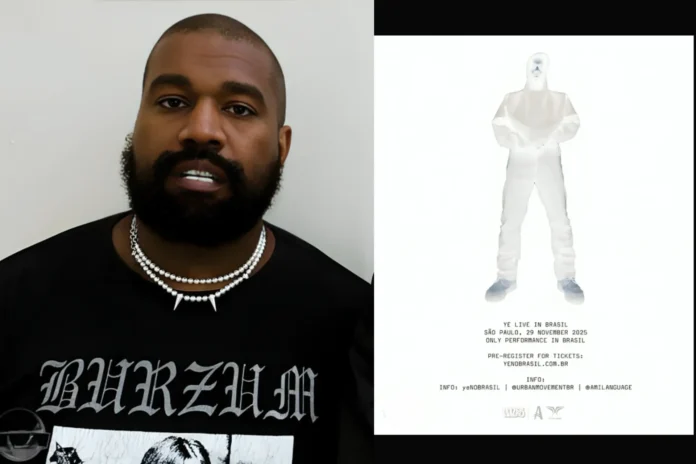
Police in São Paulo have been ordered to arrest the US rapper Ye, formerly known as Kanye West, on the spot if he performs his song “Heil Hitler” or makes any statement supporting Nazism during his concert on 29 November. The directive from the São Paulo State Public Prosecutor’s Office (MPSP) also extends to promoters Guilherme Cavalcante and Jean Fabrício Ramos, known as Faublous Fabz, who could face charges for failing to prevent prohibited content.
A tweet from X.
The order, issued on 12 November by prosecutor Ana Beatriz Pereira de Souza Frontino, follows a complaint filed by city councilwoman Cris Monteiro. It invokes Article 20 of Law 7.716/1989, which criminalizes the practice, inducement or incitement of discrimination based on race, ethnicity or religion, with penalties of one to three years in prison. A separate clause bans the manufacture or distribution of Nazi symbols for propagandistic purposes, carrying two to five years’ imprisonment.
Ye’s history of antisemitic statements provides the backdrop. In October 2022 he tweeted he would go “death con 3 on JEWISH PEOPLE”, praised Adolf Hitler in an interview with Alex Jones, and lost partnerships with Adidas and Gap worth an estimated $1 billion, according to Forbes. On 7 February 2025 he posted on X:
“I’m a Nazi” and “Some of my best friends are Jewish and I don’t trust any of them.”
In May 2025 he released the track “Heil Hitler”.
The original venue, Interlagos racetrack, was withdrawn by São Paulo City Hall. Mayor Ricardo Nunes stated:
“No one who promotes Nazism will play or sing”
on public property. Promoters are seeking an alternative site; no new location has been confirmed.
Ye met Rabbi Yoshiyahu Yosef Pinto recently and apologised for past remarks, citing his bipolar disorder diagnosis, Billboard reported. He has made no public comment on the Brazilian order.
The Cyber GAECO police unit will monitor the event and Ye’s social media. If the concert proceeds, any Nazi reference would trigger arrest in flagrante delicto.
Brazil’s stance reflects its post-dictatorship rejection of authoritarian symbols the country is home to roughly 120,000 Jewish citizens. The case tests the boundary between artistic expression and hate-speech laws, which are stricter than in the US or UK, where First Amendment protections often prevail.
Touring artists now face heightened scrutiny abroad. Australia revoked Ye’s visa earlier this year over the same song. The São Paulo directive signals that local organizers share liability, a precedent that could deter promoters in other jurisdictions with similar statutes.