

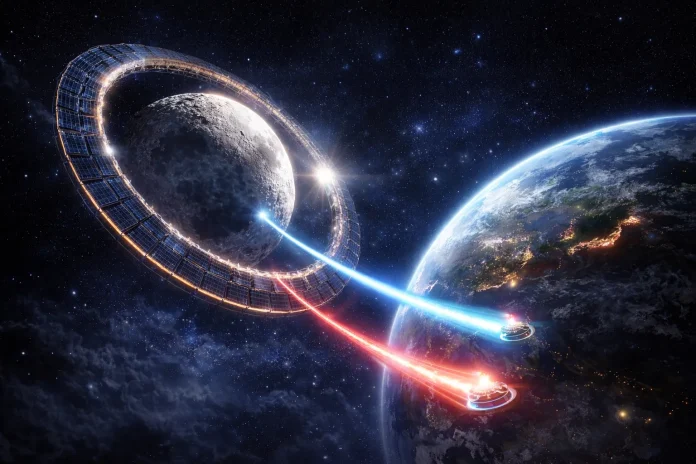
A futuristic vision of encircling the Moon with a massive belt of solar panels to beam clean energy back to Earth has resurfaced online, drawing fresh attention to one of the music industry’s favorite topics: bold, boundary-pushing ideas that could reshape how the world powers its entertainment and beyond.
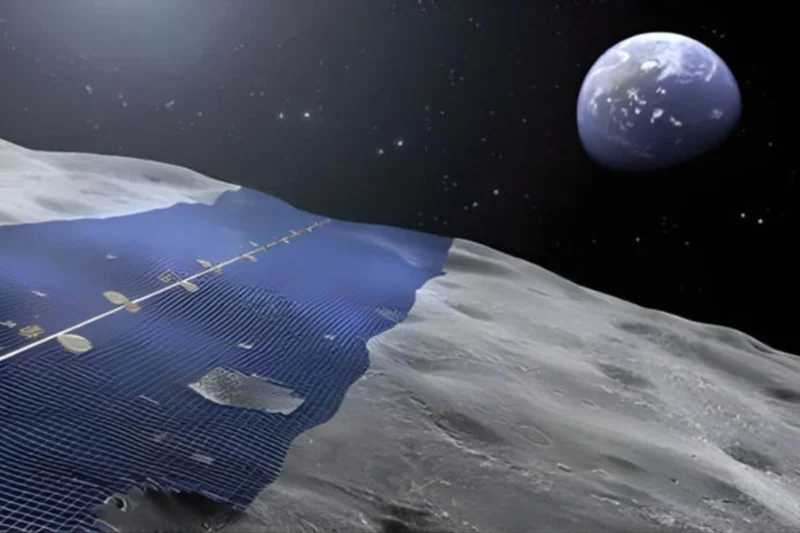
The “Luna Ring,” a long-standing conceptual project from Japan’s Shimizu Corporation, one of the country’s largest construction and engineering firms, proposes wrapping the lunar equator in a continuous solar panel structure approximately 11,000 kilometers (6,800 miles) long and up to 400 kilometers (250 miles) wide. First proposed around 2011 in the wake of the Fukushima nuclear disaster, the idea positions the Moon as a stable platform for near-constant solar power generation, free from Earth’s atmospheric interference, weather disruptions or day-night cycles.
According to details still featured on Shimizu’s official “Dream” projects page, solar panels on the lunar surface would convert sunlight into electricity, which would then be transmitted via buried cables to stations on the Moon’s near side. From there, the energy would be converted into microwave or laser beams and sent across roughly 384,000 kilometers to receiving stations on Earth — large rectennas or specialized arrays that would convert the beams back into usable electricity for the grid or hydrogen for storage.
The concept leans heavily on in-situ resource utilization, with robotic fleets processing lunar regolith (the Moon’s soil) into building materials, concrete and even solar cells on site. Human involvement would be minimal, limited mostly to remote oversight, as autonomous or tele-operated robots handle construction in the harsh lunar environment of extreme temperatures, dust and radiation.
In its most ambitious projections, the full Luna Ring could theoretically generate up to 13,000 terawatts of power — dwarfing the current global electricity demand of around 25-30 terawatts. Proponents have framed it as a path to abundant, clean energy that could reduce reliance on fossil fuels and promote “perpetual harmony with our beautiful Earth,” a message that resonates with artists and fans increasingly vocal about sustainability in the music industry and live events.
However, the project remains firmly in the conceptual stage with no active development, government funding or involvement from JAXA, Japan’s space agency. Early optimism, including a suggested 2035 construction start date floated in 2013 materials, has not materialized. Shimizu continues to present the Luna Ring as an inspiring long-term “dream” rather than a funded initiative, and recent viral posts in 2025-2026 have recirculated striking artistic renderings without any new technical breakthroughs.
Engineering challenges are significant. The scale of building a continent-sized structure on another celestial body would likely cost trillions of dollars and span decades. Key hurdles include reliable power beaming over vast distances (current demos are limited to small scales), protection against lunar dust that could degrade panels, extreme temperature swings, micrometeorites and the complexities of robotic autonomy amid communication delays.
While Japan pursues smaller-scale space-based solar power research through JAXA, the Luna Ring stands as Shimizu’s standalone vision. It joins a broader conversation around space-based solar power, in-space manufacturing and falling launch costs that could one day support everything from powering massive festival stages to reducing the carbon footprint of global tours.
For now, the Luna Ring serves as a striking reminder of humanity’s capacity for ambitious thinking — the kind that has long fueled innovation in music, technology and exploration alike. Whether it ever moves beyond concept art remains to be seen, but its recirculation highlights ongoing interest in radical solutions to energy demands in an increasingly electrified entertainment world.

