

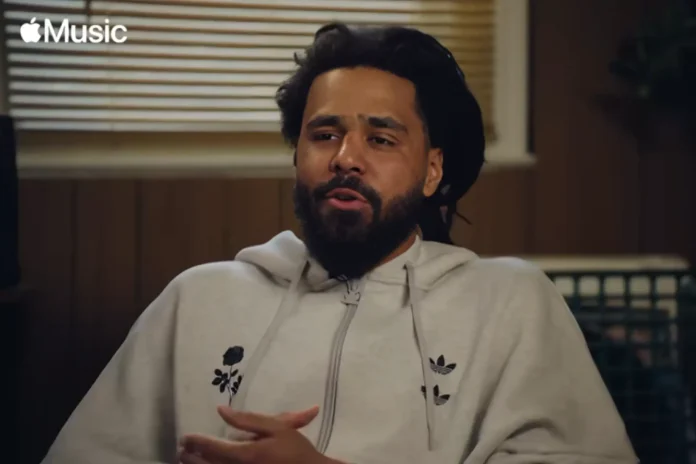
J. Cole is keeping it real about fatherhood and the internet is eating it up.
The Grammy-winning rapper says he’s straight-up not comfortable playing his favorite hip-hop tracks around his young kids because of the violent and sexual content. It’s a raw admission that’s blowing up online right now.
The moment dropped in a fresh Apple Music interview clip. J. Cole sat down with Nadeska Alexis to promote his new album The Fall-Off. The conversation happened inside his childhood home at 2014 Forest Hills Drive in Fayetteville, North Carolina the same spot that inspired his 2014 album title. That full interview hit Apple Music and YouTube on March 20, 2026.
A tweet from X.
Here’s exactly what he said in the 73-second clip that’s everywhere:
“I got a stepfather who put me on to Tupac at six, seven years old. Thank God. I can’t do that.”
He went deeper in the full talk, around the 58-minute mark. J. Cole explained his stepfather played explicit rap and violent movies with zero filter. “I’m grateful for that,” he said, crediting the early exposure for shaping his artistry and perspective. But as a dad now, he draws a hard line:
“I’m not comfortable playing my favorite songs around my kids yet, because the content is…”
He specifically called out the heavy violence, sex, and cursing in the tracks he loves including Tupac classics like those from 2Pacalypse Now.
The short video exploded after @KollegeKidd posted it on X on March 20, 2026. The caption nailed it:
“J. Cole says he’s not comfortable with playing his favorite songs around his kids.”
Within hours, it racked up tens of thousands of views and flooded timelines with debates.
Cole, who’s been married to Melissa Heholt since 2015 and keeps their two sons completely private, is showing the same protective side he’s hinted at before. He’s not knocking his own upbringing he literally says “Thank God” for it but he wants his children shielded longer than he was.
This hits hard in U.S. culture because hip-hop has always been the soundtrack for so many American kids growing up. Streaming makes every explicit track one click away, turning parenting into a daily playlist battle. Cole’s stance taps right into that tension: loving the genre that raised him while refusing to hand the same raw version to his sons.
Replies on X are split right down the middle. Some fans cheer the maturity:
“Finally, an artist actually thinking about what his kids hear.”
Others push back:
“Hip-hop raised him guided exposure with real talks is better than hiding it.”
The conversation mirrors bigger debates on how much media influence shapes child development in 2026.
J. Cole’s comments spotlight a quiet shift happening in American hip-hop families. Artists who grew up on unfiltered Tupac and street stories are now raising kids in an era of instant streaming and parental controls. He’s not rejecting the culture that built him he’s just asking when and how it gets passed down. That tension between legacy and protection feels especially real for parents nationwide right now.

