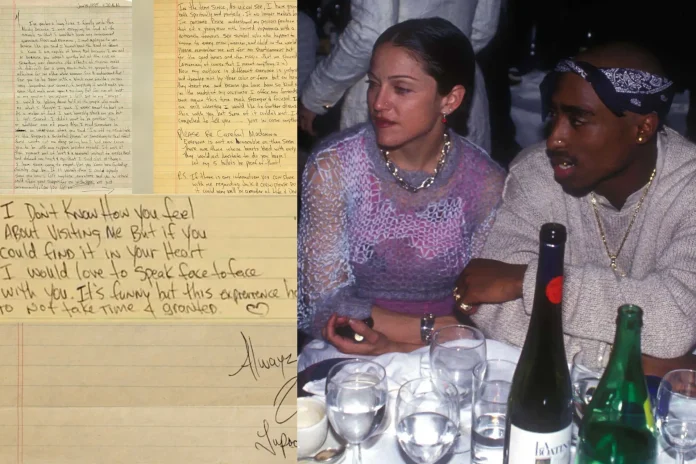
A handwritten breakup letter Tupac Shakur wrote to Madonna from prison in 1995 has gone viral again nearly three decades later, offering an intimate window into the rapper’s struggles with race, celebrity, and self-identity at the height of his fame.
The three-page letter, written in black ink on lined prison paper and dated January 15, 1995, resurfaced this week after being shared on X. The post — which includes clear photographs of the original handwritten pages — has amassed millions of views and thousands of reactions, underscoring the enduring fascination with 1990s celebrity culture and Tupac’s legacy.
In the letter, Shakur explains why he chose to end his brief but intense relationship with Madonna, citing racial politics and fear of public perception rather than a lack of affection.
“At the risk of sounding over dramatic,” Tupac writes, “the effects of racism make it difficult for a young Black man to properly show affection for an older white woman.” He argues that while Madonna’s career would not be harmed by dating a Black man — and might even benefit — his own standing with fans would suffer. He feared being seen as abandoning the Black community that embraced him or being reduced to a stereotype, a “toy” in the orbit of a white pop superstar.
The letter captures a moment when hip-hop was still fiercely protective of its cultural authenticity. For Tupac, whose upbringing was profoundly shaped by Black Panther politics and racial consciousness, the relationship triggered an internal conflict between personal desire and public responsibility.
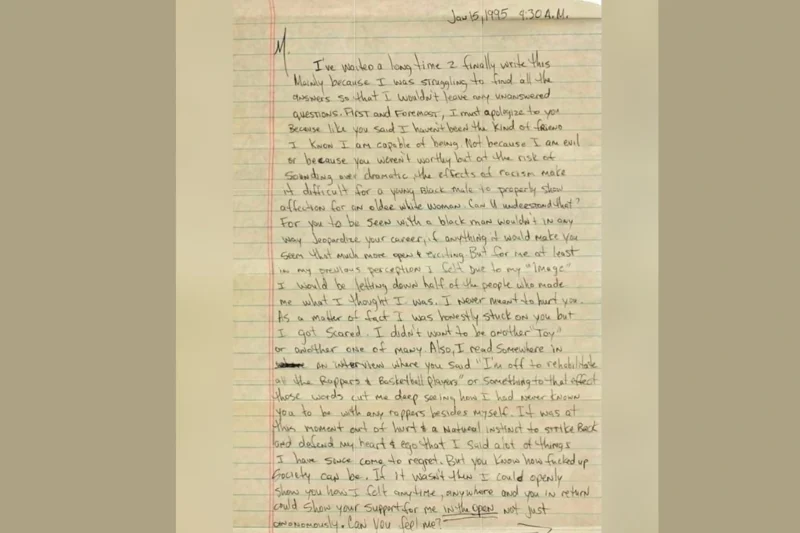
Shakur opens the letter with an apology, acknowledging that he had not been “the kind of friend” he was capable of being. He insists his distance came not from cruelty, but from confusion and pressure.
One of the most emotionally charged passages references a Madonna interview in which she joked about “rehabilitating” rappers and basketball players. Tupac writes that the comment “cut me deep,” making him feel reduced to a stereotype rather than respected as an individual. He admits that, acting out of hurt and ego, he lashed out verbally afterward — a rare admission of emotional vulnerability from an artist often framed solely as aggressive or defiant.
Fans online have reacted strongly to this section, noting how clearly it reflects the racialized stereotypes Black men faced in both mainstream media and interracial relationships during the era.
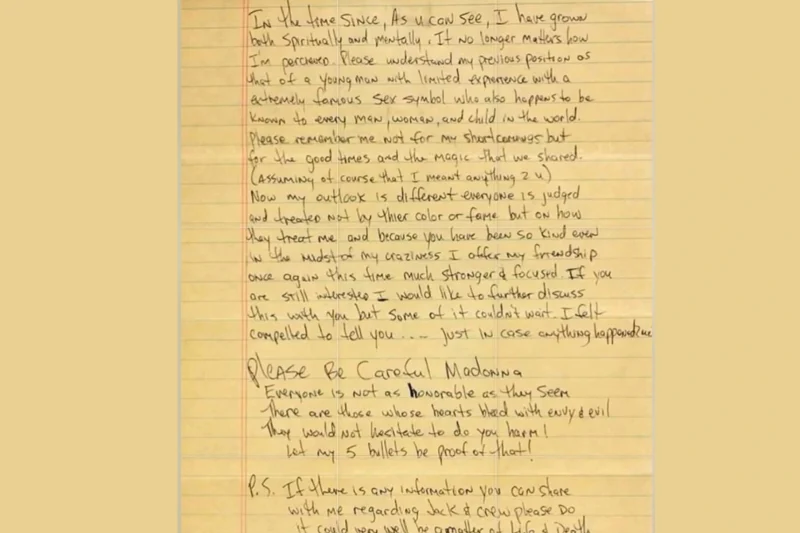
The letter also carries a darker tone. Tupac urges Madonna to “be careful,” warning her that envy and malice often hide behind friendly faces. He points to his own near-fatal shooting at Quad Recording Studios in November 1994 — “Let my 5 bullets be proof of that!” — as evidence of how dangerous fame can be.
Written from Clinton Correctional Facility, where he was serving time following a sexual abuse conviction, the message reads as both reflective and ominous. In hindsight, many readers view it as tragically prescient, given Tupac’s murder in Las Vegas just over a year later, in September 1996.
Despite its context of breakup, the letter ends not with bitterness but with an offer. Tupac asks Madonna to visit him so they can speak face-to-face, writing that prison has taught him “not to take time for granted.” He offers her his friendship again, “this time much stronger & focused,” signing off simply: “Always, 2PAC / Tupac Shakur.”
That closing sentiment has struck many readers as evidence of his emotional maturity at just 23 years old — a point repeatedly highlighted in viral replies praising both his eloquence and his distinctive, almost poetic handwriting.
The resurfacing has also revived long-standing conversations about the women closest to Tupac. Madonna later confirmed their relationship in a 2015 interview, when she casually revealed that she once dated Tupac Shakur, confirming a long-rumored connection between the pop icon and the late rap legend. During an interview with Howard Stern, the singer traced her notoriously tense appearance on The Late Show With David Letterman in the 1990s back to her relationship with Tupac.
“I was dating Tupac Shakur at the time, and the thing is he got me all riled up on life in general,” Madonna said. “So, when I went on the show, I was feeling very gangsta.”
At the time, the revelation sparked curiosity — and skepticism. Many wondered whether the relationship was simply a brief fling or something more substantial. Now, a newly revealed letter written by Tupac from prison suggests the romance carried far more emotional weight than previously understood.
The letter first came to public attention in 2017 when it was put up for auction, despite Madonna’s legal attempt to block the sale on grounds of privacy. It ultimately sold in 2018 for a reported six-figure sum, following an initial valuation of nearly $23,000. Its viral reappearance in late 2025 demonstrates how artifacts from the 1990s now function as cultural touchstones, reinterpreted by new generations.
Dated January 15, 1995, at 4:30 a.m., the three-page handwritten letter was penned while Tupac was incarcerated at New York’s Clinton Correctional Facility. Portions of the letter were later published by TMZ, offering a rare glimpse into the rapper’s private thoughts during a turbulent moment in his life. In it, Tupac reflects on a fight between the two, apologizes for past behavior, and candidly addresses the pressures he felt while dating one of the most famous women in the world.
More than celebrity gossip, the letter resonates because it exposes the emotional cost of fame, race, and public image — especially for a young Black artist navigating a predominantly white entertainment industry. It humanizes Tupac Shakur beyond the mythology of the “thug poet,” revealing a man grappling with love, loyalty, and fear in real time.
Nearly 30 years later, his prison letter remains not just a breakup note, but a historical document of cultural tension, vulnerability, and unfinished conversation.