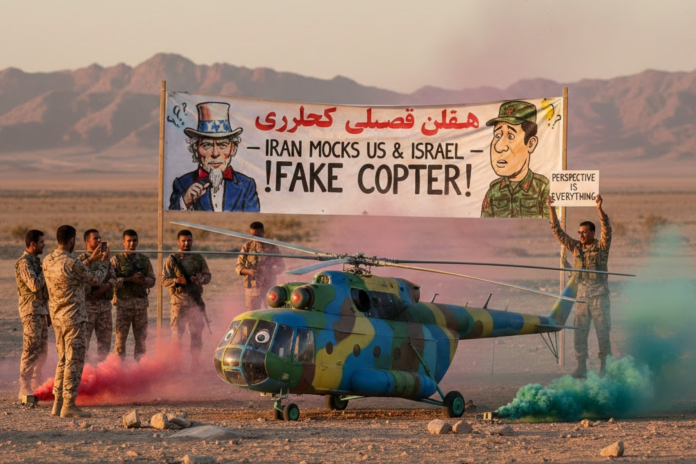
Israeli forces released thermal footage today claiming a successful airstrike on an Iranian Mi-17 helicopter, yet close examination reveals the target as a stationary painted decoy on flat ground, sparking debate over whether Tehran’s tactics amount to clever mockery or a genuine strategic edge in the escalating Middle East conflict.
This incident unfolds against the backdrop of Operation Epic Fury, the joint US-Israeli campaign that began on February 28, 2026, targeting Iranian leadership and military sites, including the elimination of Supreme Leader Ali Khamenei and other key figures in a decapitation strike. Social media users and analysts quickly pointed out inconsistencies in the video, such as the absence of rotor movement or heat signatures from engines, suggesting Iran deliberately placed low-cost replicas to draw fire and expose perceived flaws in adversary intelligence. The broader war has seen Iran retaliate with missile and drone barrages across the region, hitting US bases in Bahrain, Qatar, and other Gulf states, while suffering heavy losses to its air defenses and ballistic missile stockpiles.
Iran’s use of decoys fits a pattern of asymmetric warfare designed to frustrate superior airpower, forcing attackers to expend valuable munitions on worthless targets and buying time for real assets to reposition or counterattack. Military experts note that such deceptions, often involving inflatable or camouflaged mockups, have historical precedents in conflicts like World War II and more recent engagements in Syria, where they complicate satellite and drone reconnaissance.
In this case, the decoy’s colorful camouflage, visible in thermal imaging as a static cross shape, likely mimicked the Mi-17’s silhouette to lure precision-guided strikes, a move that not only preserves operational helicopters but also undermines confidence in the coalition’s targeting accuracy. Public reactions on platforms like X have amplified the mockery, with posts garnering thousands of views and amused comments highlighting the irony of advanced technology falling for basic tricks.
While the episode fuels propaganda narratives portraying US and Israeli efforts as wasteful blunders, it underscores a tangible threat: decoys erode the efficiency of airstrike campaigns by inflating the number of potential targets and straining resources in prolonged operations. From a journalistic standpoint, this tactic reveals Iran’s adaptive resilience amid overwhelming firepower, potentially prolonging the conflict and raising the human and economic costs for all involved parties.
Ultimately, what appears as mere taunting could shift battlefield dynamics, compelling coalitions to invest more in verification technologies and ground intelligence to distinguish real threats from illusions. For deeper context on the strikes, review the detailed timeline of the 2026 Israeli-United States strikes on Iran. Additional footage and analysis are available in the original X post and Moneycontrol’s report on the decoy strategy.