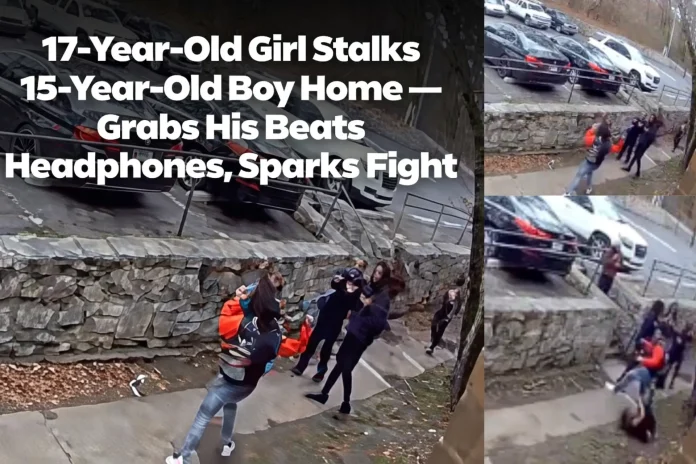
A viral video from a Chicago residential street shows a 17-year-old girl persistently following a 15-year-old boy, culminating in her yanking his Beats headphones from his neck and breaking them, which prompted him to defend himself physically. The footage, captured by a home security camera with a fisheye lens providing a distorted top-down view, depicts the boy in black attire walking briskly ahead on a sidewalk bordered by a stone wall and parked cars, while the girl in a red jacket trails closely behind, ignoring his apparent discomfort. As she catches up around the 10-second mark, she reaches for the headphones, snapping them apart and scattering pieces on the sidewalk; the boy immediately turns, pushes her against the nearby stone wall, and the altercation escalates into multiple punches as she falls to the ground. No arrests followed the incident, as the boy’s mother opted against pressing charges after discussions with the girl’s father and local authorities.
The video, lasting about 30 seconds, begins with the boy walking alone, head down, suggesting annoyance or haste to get away. The girl approaches from behind, her body language determined, closing the gap steadily over the first few seconds. At approximately 10 seconds, her aggressive grab causes the headphones to fly off; the boy’s reaction is swift, shoving her back and delivering blows while she attempts to defend herself, the struggle continuing until the clip ends around 29 seconds with them still entangled near the wall. This detailed sequence highlights the rapid escalation from pursuit to violence in a quiet, overcast residential area with bare trees indicating early spring or winter.
The confrontation stemmed from weeks of unwanted attention, according to a statement from the boy’s mother shared widely online. She explained that her son had clearly expressed disinterest, yet the girl continued following him home from school, a pattern that finally boiled over into property damage and violence. The girl’s father acknowledged her actions and agreed to replace the damaged Beats headphones, citing personal challenges she might be facing as context but not an excuse. This resolution highlights how parental intervention can de-escalate teen conflicts, though it also raises questions about addressing underlying behaviors early to prevent harm.
Public reaction to the video, which has garnered millions of views across social media platforms, reveals a divide in opinions on gender dynamics and self-defense. Many viewers praised the boy for standing up against harassment, noting that if the roles were reversed, the response might label the pursuer as a stalker more readily. Others called for greater emphasis on teaching all young people about consent and boundaries, echoing data from the Centers for Disease Control and Prevention that indicates about 10 percent of high school students experience physical dating violence each year. The incident underscores the risks when rejection is not respected, potentially informing school programs aimed at fostering healthy interactions.
As a journalist covering youth and community issues, this event serves as a reminder that harassment knows no gender boundaries and demands equal accountability to protect vulnerable teens. While the informal settlement avoided court involvement, it might encourage other families to seek school counseling or mediation before situations turn physical. Broader societal efforts, including resources from local authorities like the Chicago Police Department, could help by promoting awareness campaigns on stalking and assault prevention. Ultimately, prioritizing education on mutual respect may reduce such escalations, ensuring safer environments for all adolescents navigating complex social dynamics.