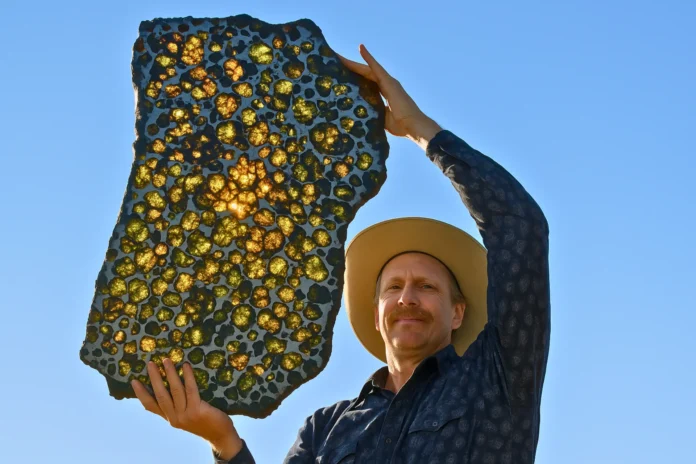
A 4.5-billion-year-old cosmic treasure, the Fukang meteorite, crashed into the mountains near Fukang, China, and continues to captivate scientists and collectors alike. Discovered in 2000 in the Gobi Desert, this extraordinary find offers a glimpse into the early solar system. Its shimmering beauty and rarity make it one of the most remarkable meteorites ever uncovered. The Fukang meteorite is a pallasite, a rare type of stony-iron meteorite that makes up less than 1% of all known meteorites.
It features a stunning mix of translucent, golden-green olivine crystals, some as large as golf balls, embedded in a metallic iron-nickel matrix. These olivine crystals, often gem-quality and known as peridot, give the meteorite a stained-glass-like appearance when polished and backlit. This unique combination of silicate and metal sets it apart as a visual and scientific marvel. Weighing an impressive 1,003 kilograms (2,211 pounds) when found, the meteorite was discovered by an unnamed hiker who noticed its unusual appearance during treks in the Fukang Mountains.
The hiker chipped off fragments, which were sent to the United States for analysis. Experts, including researchers at the University of Arizona, confirmed its extraterrestrial origin, sparking global interest. In 2005, the meteorite debuted at the Tucson Gem and Mineral Show, where its beauty stunned attendees. Scientists believe the Fukang meteorite formed at the core-mantle boundary of a differentiated asteroid, a small celestial body from the early solar system.
Its 4.5-billion-year age aligns with the formation of our solar system, making it a valuable relic for studying planetary origins. The meteorite likely survived a violent collision in space before landing on Earth, a rare feat given the fragility of pallasites during atmospheric entry. The meteorite’s value extends beyond science. Its rarity and beauty have driven high demand among collectors.
In 2008, a 420-kilogram portion was offered at auction in New York for an estimated $2 million, though it did not sell. Smaller fragments have fetched impressive prices, with a 150-gram slice selling for $30,000 in 2021 and some pieces valued at up to $1,000 per gram. The meteorite’s gem-quality olivine has even been crafted into jewelry, such as wedding rings, blending cosmic history with human artistry.
Today, slices of the Fukang meteorite are displayed in museums like the Smithsonian Institution and the Natural History Museum in Vienna, where they inspire awe. Researchers continue to study its composition to unlock secrets about the solar system’s formation, while collectors treasure its otherworldly beauty.