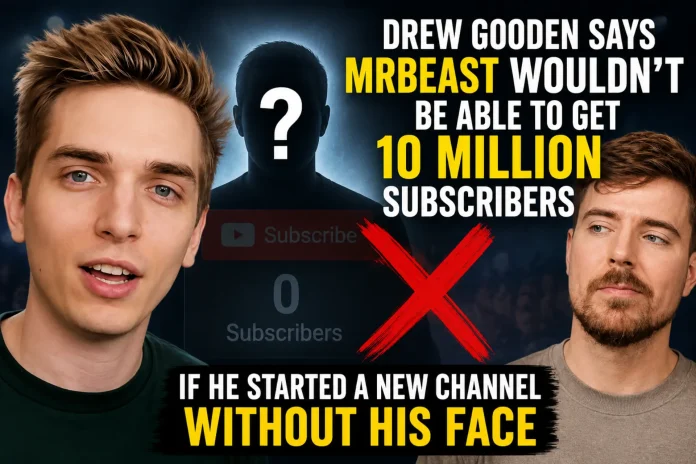
YouTuber Drew Gooden has directly challenged whether Jimmy Donaldson, widely known as MrBeast, could grow a completely new channel to ten million subscribers without ever showing his face, countering the creator’s longstanding position that his understanding of the platform would make such growth possible within months.
Donaldson first made the claim during a lengthy conversation recorded in 2023. He stated that he could launch a fresh channel without using his face or voice and without any promotion, reaching between ten and twenty million subscribers in roughly six months. The comments center on the idea that success stems primarily from replicable knowledge of what drives views, retention, and algorithmic performance rather than personal identity or existing audience. Those remarks appear in the latter portion of the Lex Fridman Podcast #351 interview and have been widely referenced in recent weeks following Donaldson’s major milestone on the platform.
Donaldson crossed five hundred million subscribers on his main channel on June 12, an achievement confirmed by major outlets including TODAY that came after years of escalating production values, large-scale giveaway-driven challenges, and consistent high output. Gooden addressed the earlier statement in a new interview this month, expressing clear skepticism. He said he does not believe the outcome would be the same without the established brand and added that he would delete Donaldson’s current channel if given the opportunity, forcing a true test of the strategy. Gooden also used the discussion to voice concerns about the growing presence of generative artificial intelligence content across YouTube.
The exchange highlights a central tension in today’s creator economy. Many observers have long debated how much of Donaldson’s extraordinary growth comes from deep platform knowledge versus the combination of recognizable personality, substantial production resources, team support, and accumulated trust with audiences. Gooden’s full response appears in his recently published “Why was I invited to Beast Studios?” video, where he suggests that even sophisticated strategy may prove difficult to replicate in isolation, especially when starting without name recognition or the infrastructure that supports large-scale content. Several creators have attempted faceless or low-profile approaches, including the anonymous creator behind the 10-hour fireplace video that earned over a million dollars, and encountered steep barriers in initial discovery and sustained engagement.
Donaldson has repeatedly described his process as methodical and heavily data informed, with constant testing of thumbnails, titles, pacing, and audience signals. Supporters of his view argue that the underlying principles of effective video making can be learned and applied broadly. Critics, including Gooden in this instance, point out that execution at scale often requires capital, relationships, and a personal hook that help content break through in a crowded environment, a formula visible in stunts like MrBeast’s 100-day private jet pilot competition. The timing of Gooden’s comments, coming shortly after the five hundred million subscriber mark, has renewed attention to these questions at a moment when many aspiring creators are searching for replicable paths to growth.
Public discussion around the remarks has been divided. Some see Gooden’s position as a realistic assessment of the advantages that come with an established operation. Others view it as underestimating the depth of Donaldson’s platform expertise and work ethic. The conversation echoes similar debates that have surfaced whenever major creators discuss the ingredients of their success, particularly as algorithms evolve and competition intensifies.
The original interview containing Donaldson’s comments remains publicly available for anyone who wants to hear the full context. Gooden’s more recent remarks appear in a separate conversation filmed earlier this month. Both recordings offer primary source material on the differing perspectives without additional framing.
At its core, the back and forth reflects ongoing questions about attribution in digital media. While technical knowledge and consistent improvement clearly play important roles, audience building frequently involves factors that extend beyond strategy alone. As platforms continue to change and new creators enter the space, these conversations are likely to remain relevant for anyone trying to understand what it takes to achieve significant reach today.