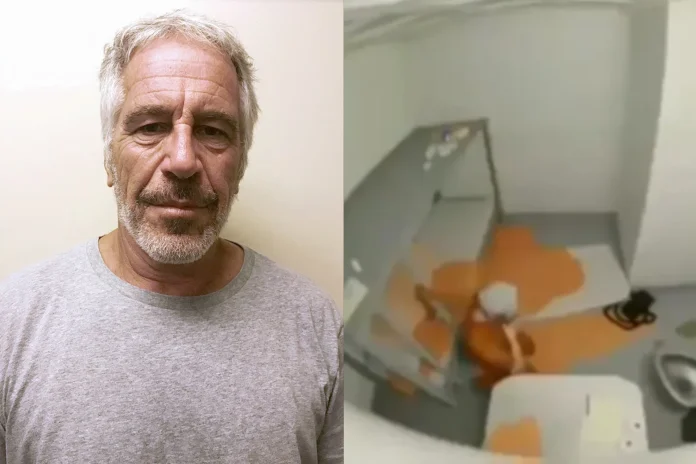
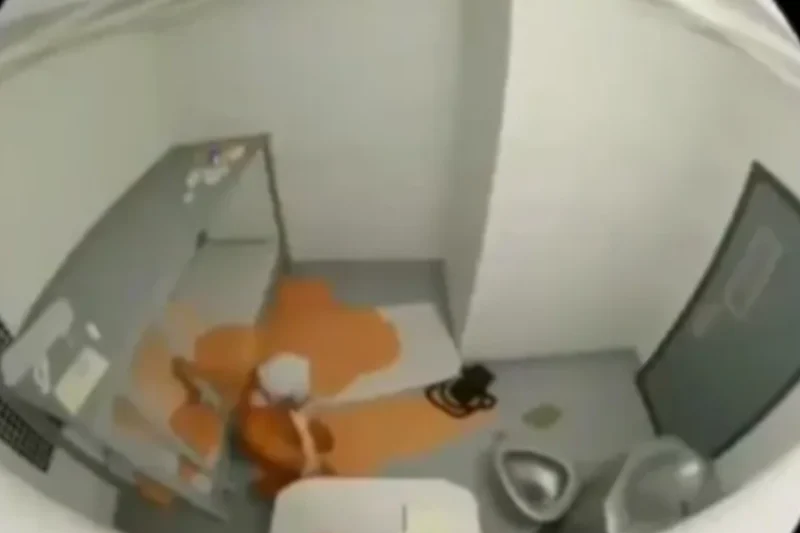
The U.S. Department of Justice briefly posted a 12-second video purporting to show Jeffrey Epstein attempting suicide in his jail cell as part of its newly declassified Epstein files before removing the clip, after analysts confirmed it was not authentic.
The video appeared on the DOJ’s website between Dec. 21 and 22, 2025, timestamped Aug. 10, 2019, at 4:29 a.m. — roughly two hours before Epstein was found dead in his cell at New York’s Metropolitan Correctional Center (MCC) at approximately 6:30 a.m. The clip quickly spread online after being picked up by outlets including TMZ, which labeled it a “DOJ video” and described the footage as “graphic.”
Within hours, the video was taken down. Subsequent reporting and forensic analysis determined that the footage was a long-debunked computer-generated animation that had circulated on the internet for years.
Credit : DOJ
Investigators found that an earlier and more precise version of the same animation had been uploaded to YouTube roughly five years ago and later shared on X (formerly Twitter) in November 2025 alongside conspiracy theories surrounding Epstein’s death. The clip is believed to have originated on 4chan, where it was repeatedly reposted as a speculative animation.
Multiple inconsistencies flagged the video as fake. Visual analysis revealed flat, non-three-dimensional elements that were inconsistent with real surveillance footage. The cell door depicted does not match images of Epstein’s actual cell released by the Bureau of Prisons, and the lighting shown — fully illuminated throughout — would only be standard for inmates on suicide watch.
According to Bureau of Prisons records, Epstein had been removed from suicide watch on July 24, 2019, more than two weeks before his death. In addition, the manner of death portrayed in the animation does not align with how Epstein was found, as detailed in a Bureau of Prisons incident report released in June 2023.
Most notably, the Bureau of Prisons has stated that no camera was recording video inside Epstein’s cell on the night of his death. The only available footage from that evening came from a hallway camera outside the cell, which did not provide a clear view of the interior.
The DOJ has not explained how the fabricated video ended up in its official Epstein file release. The clip appeared in “DataSet 8” of the DOJ’s Epstein Library without context or explanation. According to reporting, a Florida-based conspiracy theorist alerted investigators to the animation, prompting its removal.
The department declined to comment on the incident and has not issued a public clarification addressing how the video was included or why it was not vetted before publication.
The episode adds to the ongoing scrutiny of the DOJ’s handling of Epstein-related materials. Earlier in 2025, forensic analysis revealed that surveillance footage released by the DOJ in July — described at the time as “raw” — had been edited using Adobe Premiere Pro, stitched together from multiple clips, and contained a one-minute gap during a critical time window. Those findings, reported by WIRED and independent experts, fueled renewed skepticism about the authenticity and completeness of official releases.

The Epstein Files Transparency Act mandated the December 2025 disclosure, signed into law by President Donald Trump on November 19, 2025. The law required the DOJ to release all unclassified Epstein-related materials within 30 days, by Dec. 19. On that date, Deputy Attorney General Todd Blanche acknowledged the deadline would not be met, announcing that only “several hundred thousand” documents would be released initially, with more to follow in the coming weeks.
CBS News reported that the initial release included 3,965 files totaling roughly 3 gigabytes of data, with at least 550 pages fully redacted.
Lawmakers from both parties criticized the partial release. Reps. Thomas Massie (R-Ky.) and Anna Eshoo (D-Calif.), co-sponsors of the transparency legislation, said the DOJ was not complying with the law. At the same time, Sen. Ron Wyden accused the administration of continuing a cover-up.
Epstein survivors also raised concerns, arguing that extensive redactions undermined the transparency measure’s intended purpose.
As additional Epstein-related files are expected to be released in the coming weeks, the brief posting of a fabricated video has intensified questions about the DOJ’s vetting process and its broader commitment to transparency.