

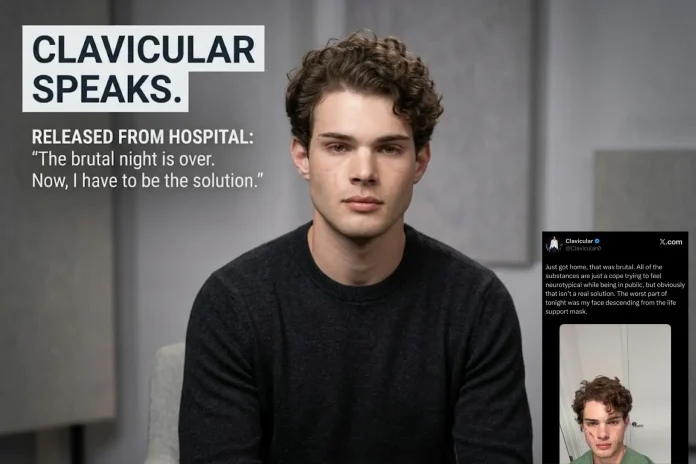
Braden Peters the 20-year-old streamer known online as Clavicular has issued his first public statement since leaving a Florida hospital after a suspected overdose that unfolded live on one of his Kick broadcasts. In the message he openly describes the ordeal as brutal and frames his substance use as a short-term way to feel neurotypical in public settings while stressing that it provides no sustainable solution. He points to the physical trauma of his face pressing against the life support mask as the most distressing part of the experience. This marks his initial direct address to followers following the abrupt end of his April 14 stream in Miami when he became unresponsive and emergency services responded.
Peters posted the update on the morning of April 15 shortly after arriving home in the Miami area alongside a recent photograph showing fresh facial abrasions from medical intervention and a contrasting pre incident portrait. The reflection arrives against a backdrop of repeated high-risk behaviors that have defined much of his rapid rise in the looksmaxxing community. Since beginning self-experimentation with testosterone injections at age 14 he has pursued extreme physical alterations including bone smashing steroids and crystal meth for leanness all while building a streaming career that earns him substantial income through fan donations and subscriptions. These choices have led to documented incidents such as injecting his then 17-year-old girlfriend with fat dissolving peptides during a November 2025 livestream and accelerating his Tesla Cybertruck into a pedestrian in Miami on December 24, 2025, an event he later described as self defense after claiming the man had been stalking him. Full details of his background and timeline appear in his Wikipedia entry.
Additional controversies have compounded the pattern. In late December 2025 and January 2026 Peters was filmed chanting along to an antisemitic Kanye West track in a Miami nightclub alongside figures including Andrew Tate and Nick Fuentes prompting club bans and public backlash. Early February 2026 brought an arrest in Scottsdale Arizona for possession of a forged instrument and dangerous drugs though charges were later dropped. By late March he faced a misdemeanor battery arrest in Florida related to an alleged instigation of a fight between two women at a residence he had rented with video of the altercation posted online. He has also appeared in a chokehold stunt during an April 3 livestream that left him unconscious and convulsing while earlier emotional breakdowns on stream revealed feelings of manipulation and isolation in relationships. The original statement and accompanying images can be viewed at his verified X account with further context in a dedicated update repost.
This latest hospitalization underscores broader vulnerabilities that many streamers encounter when constant public performance collides with underlying mental health needs. Peters has referenced being on the autism spectrum including periods of non verbal communication as a teenager and his recent admissions highlight how substances have served as a coping tool amid the demands of always on content creation. In the streaming world where creators maintain near nonstop broadcasts to retain audiences the pressure often leads to burnout anxiety and reliance on stimulants or other aids to sustain energy and social functionality. Research indicates heavy social media and livestream engagement correlates with heightened risks of depression attention issues and sleep disruption particularly for young adults navigating rapid fame and scrutiny. His case illustrates how the pursuit of viral authenticity and physical optimization can mask deeper struggles with neurodivergence and emotional regulation.
The statement offers a rare moment of self awareness from a figure whose content has long emphasized extreme self improvement over balance. At 20 Peters continues to operate independently without traditional management navigating legal matters and audience expectations while his earnings reportedly exceed six figures monthly. Public reactions have included calls for professional support alongside ongoing debates about accountability in digital spaces. As he processes this recent event his words suggest an emerging recognition that past approaches may require reevaluation to prioritize long term stability. For creators in similar positions this could highlight the value of integrating mental health resources into the demands of streaming rather than treating them as secondary to content output.

