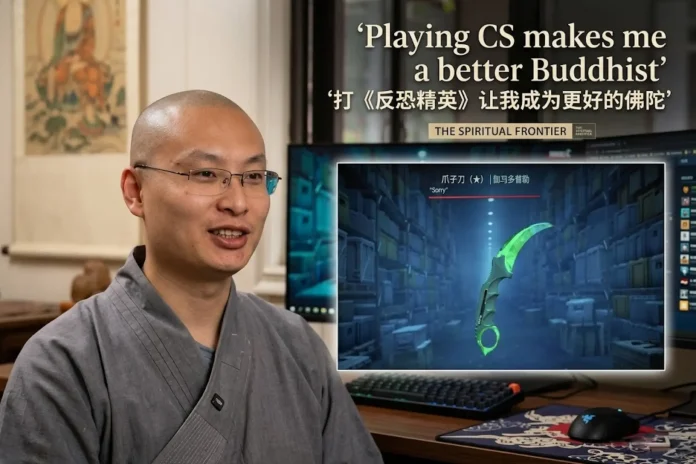
A Chinese Buddhist monk has declared that playing Counter-Strike has strengthened his spiritual practice by sharpening concentration, fostering teamwork and empathy, and deepening his understanding of impermanence through the game’s inevitable round losses and fleeting victories.
Venerable Huayan, a monk for over 20 years at Zhong Putuo Temple in Wenzhou, Zhejiang Province, began competing in the tactical shooter as a primary school student in Shanghai during the early 2000s. He once reached the high Legendary Eagle Master rank on international servers in CS:GO and now plays more casually for relaxation after completing daily temple duties. In a widely viewed interview, he displayed a high-end custom PC featuring an RTX 4090 graphics card valued at around 40,000 RMB, along with a rare Karambit Gamma Doppler Emerald knife skin estimated near $9,000.
Huayan explained that the fast-paced decisions required in Counter-Strike 2 mirror core elements of Buddhist training. He stated that “gun skill is also Dharma, and bullet trajectory is also the Way,” framing precise aim and strategic movement as extensions of mindful awareness rather than sources of aggression. Virtual eliminations carry no real hatred or attachment, distinguishing them from actual harm and aligning the activity with monastic precepts. Team play cultivates communication and mutual support, qualities essential both in matches and in communal temple life.
For frustrations such as encountering cheaters, he draws on traditional wisdom like the advice from Buddhist figures Hanshan and Shide: endure, yield, and let the system’s own rules deliver consequences while maintaining inner calm. The monk further connected gameplay to the Buddhist concept of impermanence, urging players not to let a single 40-minute match spoil an entire day. One bad round or tilt moment passes quickly, much like transient emotions in everyday existence. He treats the game as a practical arena for emotional regulation, where rapid shifts in momentum teach acceptance and resilience without attachment to outcomes.
In the interview conducted by Douyin creator 大胜CS2 and originally posted around April 10, 2026, Huayan sat calmly in simple monastic clothing, smiling occasionally while sharing lighthearted details about his inventory. He jokingly referred to one knife skin as “Sorry” for friendly fire incidents and another as “nice” for clean kills, blending humor with philosophy. These moments highlighted his relaxed integration of modern hobbies into traditional routines, where he might spend half an hour unwinding with friends in casual modes after morning practices. The contrast between his serene presence and the competitive intensity of Counter-Strike 2 captured public imagination.
This unexpected profile invites reflection on how digital entertainment can complement rather than conflict with contemplative traditions. Huayan’s approach demonstrates that focus honed in high-stakes virtual scenarios can enhance real-life mindfulness, offering gamers a fresh lens through which to view tilt, cooperation, and recovery from setbacks. In a time when many struggle with emotional regulation in competitive online spaces, his perspective provides accessible wisdom rooted in centuries of Buddhist insight.
It also prompts consideration of personal boundaries in monastic life, where individual monks navigate modern tools while preserving core commitments to non-harm and self-awareness. This story echoes broader discussions in the hip-hop and celebrity world about balancing personal passions with public image and discipline, much like artists who channel intense creative energy into focused practice.
For those exploring Buddhist teachings on mindfulness in daily activities, resources on impermanence and mental discipline offer valuable context. Details on Counter-Strike 2 community guidelines and gameplay can be found through official Valve documentation. Current market trends for premium CS2 knife skins, including the Gamma Doppler Emerald pattern, appear on established skin pricing trackers. Broader discussions of technology and religion in contemporary China appear in academic overviews of modern monastic practices.