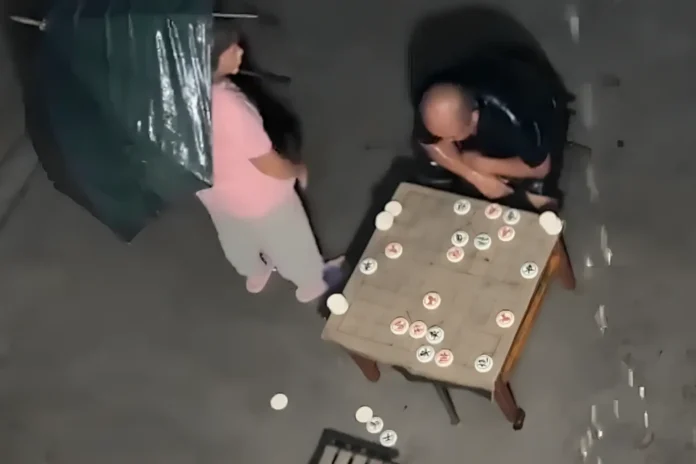
The rain fell in thick sheets, pounding the stone pavement of a tiny public park in northern China. Behind a tiny wooden table sat a middle-aged man, drenched through and through, his eyes intently locked upon a board of Xiangqi. For nearly four hours, he neither moved nor spoke, replaying the match he had just lost one move at a time.
His wife waited outside with an umbrella, coaxing him inside. Eyewitnesses say that she returned a couple of times but he wouldn’t move and wanted to see where the game went wrong.
“It’s just a game,”
A stranger is seen telling in the video that went viral. But to the man, it was something more.
The video first emerged on August 29, 2025, uploaded on X by Dexerto and quickly went viral on YouTube, Reddit, and Chinese social media including Weibo. The video had gained millions of views and attracted world-wide curiosity in a matter of hours.
Main dailies like South China Morning Post, The Times of India, and The Weather Channel covered the story by August 30 and framed it in the context of a profile of infatuation and passion regarding one of China’s most loved games.
In the video, the man is leaning forward in a soaked and motionless state with torrents of rain flowing across his shoulders. Vacant chairs in the vicinity suggest his opponent long gave up the field but he kept moving pieces to and from the table in order to sift through each possibility he possibly overlooked.
A tweet from X.
The chess community quickly weighed in. Hans Niemann, an American grandmaster, shared the clip on X, writing:
“I’ve been there — Mumbai 2019. Heavy rain, heartbreaking loss, sitting for hours under a leaking tent, replaying every move. I get it.”
Dutch grandmaster Anish Giri responded with characteristic humor:
“If I ever lose like that, I promise to choose a dry room for my existential crisis.”
Users across social platforms expressed a mix of empathy and amusement. Some praised the man’s dedication others related it to their own quiet struggles after personal defeats.
You have to look at Xiangqi, or more colloquially Chinese chess, to understand why this moment resonated so deeply. With millions playing daily in Vietnam and China, the game itself has existed for more than a thousand years. Parks and tea houses invite impromptu matches where small crowds gather to debate strategy and replay positions long after they’re done playing the game.
Unlike in global chess, Xiangqi has unique mechanics such as cannons that jump in order to attack and a river that divides the board that make strategy complicated and very rewarding. Playing Xiangqi is often associated with intelligence, discipline, and honor in Chinese society.
“Xiangqi is not just a game,”
Explains Dr. Wen Liu, a Beijing-based cultural historian.
“For many, it’s a form of mental training and a mirror of personal resilience. Losing can feel like losing face and reflecting on mistakes is considered virtuous.”
This small scene a lone man battling personal disappointment at a chessboard has struck a universal chord. It’s about pride and passion and the quiet devastation of defeat. In a world of computers where local footage is transmitted across continents in seconds, the story reveals the power of human feeling to transcend culture and language.
Like Niemann characterized it,
“We’ve all had games or experiences we can’t move on from. His just came in the rain.”
Eventually, the peaceful introspection of the stormy heavens-watching Hebei man has crossed a viral video threshold. It is a reference to the transcendent threads of madness, endurance, and compassion and the ability of a personal game of Xiangqi on a small wooden game board to resonate long beyond a provincial park gate.