

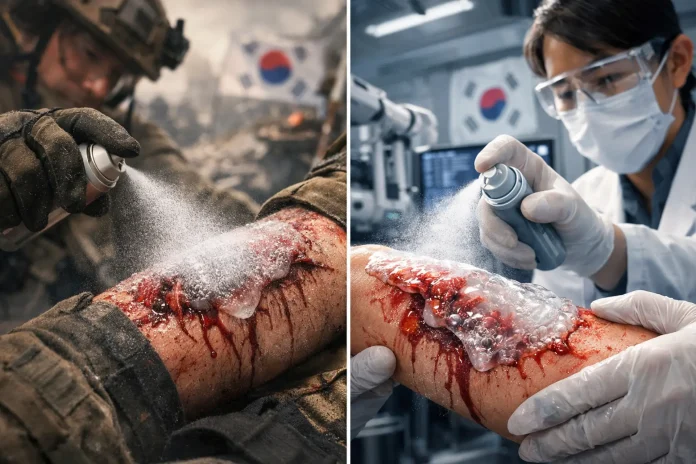
South Korean scientists at KAIST have come up with this incredible new thing called AGCL Powder it’s a spray-on stuff that stops bleeding super fast, like in about a second. It turns into a hydrogel barrier when it hits blood and can soak up a ton of fluid, up to 725% of its own weight. They revealed it on December 29, 2025, and it’s been getting a lot of buzz ever since.
The news blew up on social media, with folks joking about how it’s basically real-life Med Mist from Fortnite. It’s funny, but the actual tech is all about saving lives in serious situations, not video game perks.
A tweet from X.
Quick-stop bleeding agents are huge in emergency medicine, war zones, and accidents, where losing too much blood leads to way too many avoidable deaths. According to the WHO, trauma kills around 5.8 million people a year worldwide, and bleeding accounts for 30-40% of that.
Stuff like QuikClot uses kaolin to kickstart clotting, but it can take minutes and sometimes causes burns from the heat it generates. Celox relies on chitosan to make a seal, but it doesn’t always work great on weird-shaped or deep cuts. Newer polymers and hydrogels are better, but they often fall short on speed or how well they adapt to different wounds.
AGCL is still in the early testing phase no human trials yet, just lab and animal stuff but it’s looking promising. As the KAIST team put it in their release, it’s gone through successful tests on wound models, but it’s not approved or ready for people.
The powder mixes natural ingredients: alginate and gellan gum that gel up quick with calcium from blood, chitosan for sticking to blood and fighting bacteria, and lysine to keep it all stable.
Spray it on, and it reacts with blood’s calcium to form a tough hydrogel in roughly one second. That barrier halts the bleed and absorbs a massive amount of blood thanks to its spongy 3D setup. Stats-wise, it’s got adhesion over 40 kPa, super low hemolysis (under 3%), cell viability above 99%, and it kills 99.9% of bacteria.
In the paper from Advanced Functional Materials, they explain how it “instantly interacts with the blood’s calcium to transform into a strong, solid hydrogel barrier in approximately 1 second.”
Animal tests, like on pig arteries, showed way less blood loss, faster stopping, and better healing. One experiment had it working fully in 92% of bad wounds compared to 60% for the usual methods. Wounds healed with more blood vessels and collagen, and liver tests went back to normal in two weeks.
Of course, there are hurdles needs human trials, as the study stresses. Professors Steve Park and Sangyong Jon led the work, noting in experiments it cut blood loss and time to stop bleeding, plus sped up healing, vessel regrowth, and collagen buildup.
This could change the game for trauma care in hospitals, disaster areas, or out in the middle of nowhere. It’s got big military vibes too, especially since a South Korean Army major was involved bleeding is the number one killer in combat.
It might even help in surgeries for internal cuts. With more conflicts and disasters popping up, tools like this fit right in with goals to drop pre-hospital deaths by 20-30%, like what the U.S. military’s been pushing.
A Dexerto post on X really spread the word, mixing the South Korean flag with Fortnite pics. People chimed in with jokes like “real-life Med Mist,” and by January 15, 2026, it had racked up millions of views.
While the memes are entertaining, it’s important to keep the facts straight. Dexerto pointed out how the post’s images sparked those gaming comparisons, boosting shares among gamers.
Remember, AGCL isn’t approved yet no clinical trials or okay from regulators. Things like blood thinners or tricky wounds might throw it off in the real world. The team warns that effectiveness could vary, and like with past hemostatics that got recalled, it needs thorough checks from bodies like South Korea’s MFDS or the FDA.

