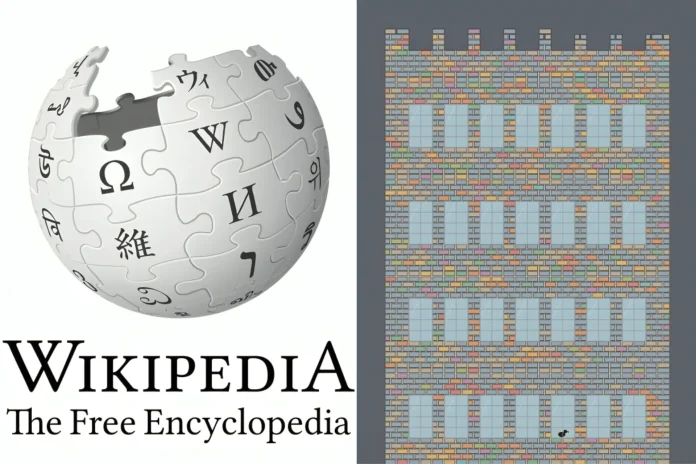
Watching the world’s largest encyclopedia grow, brick by brick, in real time not as lines of text on a screen, but as a towering digital skyscraper stretching endlessly upward. That’s exactly what the viral website Babel does. Launched in mid-July 2026, this creative project turns every single Wikipedia edit into a colorful brick added to a continuously building 3D visualization.
Created by independent developer repsels, Babel (accessible at babel.reppie.org) pulls from Wikipedia’s public edit stream. Each edit whether a quick typo fix, major article expansion, or bot maintenance becomes one brick in the structure. Hover over any brick, and details pop up: the article title, the exact text change (the “diff”), the language edition, and a direct link to the original Wikipedia edit.
“Every brick an edit,” the site declares. Bricks are color-coded by Wikipedia language versions English, French, Japanese, and dozens more creating a vibrant, layered tower. Dotted bricks mark automated bot edits. The visualization updates in near real time, with a short processing delay of a few minutes. At midnight UTC, the day’s skyscraper “closes,” gets archived for later viewing, and a new one begins building from the ground up.
On July 18, 2026, its first fully tracked day, Babel visualized 335,592 edits, resulting in a digital skyscraper measuring roughly 3,174 meters tall according to the site’s metrics. Users can scroll to “ride” the tower, pan around, toggle sound effects, and explore stats like current height and floor count.
The project quickly captured attention on Reddit’s r/InternetIsBeautiful and across X, where users praised its clever visualization of Wikipedia’s hidden collaborative engine. It joins a tradition of creative Wikimedia data projects like “Listen to Wikipedia,” but stands out with its architectural metaphor. As one Dexerto report noted, it makes the
“sheer volume and global nature of editing tangible.”
That said, Babel has limitations worth noting. Edits appear with a slight delay, and the tool doesn’t evaluate quality it visualizes everything without distinguishing vandalism from verified improvements. Viewers should approach it as an artistic representation rather than a judgment on content accuracy.
Babel is a work of art that is sure to make a lot of people in the United States excited about technology, internet culture, and creative processes in cyberspace. In an age of artificial intelligence and collaboration on the internet, it presents an absolutely fascinating glimpse into the world of work and labor required for creation of one of the most fundamental tools of internet communication.
Repsel’s masterpiece keeps growing bigger and bigger and makes it very clear that under every single mouse click and every scroll down there is a world of people who create something really big. Despite the idea of the Tower of Babel that was described in legends, this tower brings people together through its knowledge.