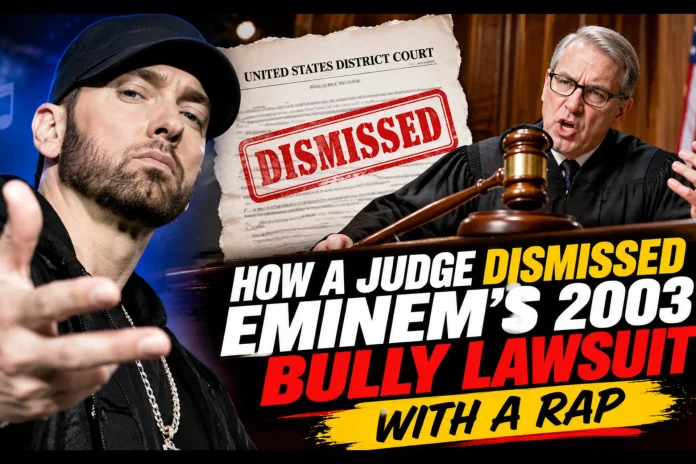
In October 2003, a Michigan judge didn’t just throw out a $1 million lawsuit against Eminem — she did it in rhyme.
Macomb County Circuit Court Judge Deborah A. Servitto dismissed claims by DeAngelo Bailey, a former schoolmate who said the rapper’s 1999 song “Brain Damage” had defamed him by portraying a brutal elementary-school beating. In a 13-page opinion, Servitto ruled that listeners would recognize the lyrics as cartoonish exaggeration rather than literal fact. Then, in a footnote, she delivered her reasoning in ten stanzas of rap verse, ending with the line: “It is therefore this Court’s ultimate position / That Eminem is entitled to summary disposition.”
The case traced back more than two decades. In the early 1980s, a young Marshall Mathers and Bailey attended Dort Elementary School in Roseville, Michigan. Mathers later described Bailey as a persistent bully who shoved him into lockers daily and once attacked him in a bathroom, banging his head against a urinal until his nose broke. A separate incident, Mathers said, left him blacked out in a snowbank.
Eminem’s mother, Debbie Mathers, sued the local school district in 1982, alleging the school failed to protect her son from repeated assaults by Bailey. Court papers claimed the attacks caused a concussion, headaches, vision and hearing problems, nightmares, and other symptoms. That suit was dismissed on governmental-immunity grounds.
When Eminem released “Brain Damage” on The Slim Shady LP in 1999, he named Bailey directly:
Way before my baby daughter Hailie
I was harassed daily by this fat kid named DeAngelo Bailey
An eighth grader who acted obnoxious, ’cause his father boxes
So every day he’d shove me in the lockers
One day he came in the bathroom while I was pissin’
And had me in the position to beat me into submission
He banged my head against the urinal ’til he broke my nose
Soaked my clothes in blood, grabbed me and choked my throat
In a Rolling Stone interview that same year, Eminem insisted the account was true. Bailey, then a sanitation worker, later acknowledged some bullying but denied the severe violence. In 2001 he sued Eminem for false-light invasion of privacy and related claims, seeking $1 million and arguing the song had damaged his reputation and ambitions as a rapper.
Judge Servitto disagreed. She found the lyrics “substantially true” in light of Bailey’s own admissions and the earlier school lawsuit. More importantly, she ruled that a reasonable listener would understand the song as rhetorical hyperbole — the kind of exaggerated storytelling common in rap — not a factual report. Other lines in the track, including claims that the principal stomped on Mathers or that his “whole brain fell out,” reinforced the point.
To make the ruling accessible “to fans of rap,” Servitto added the rhyming footnote. Key passages included:
Mr. Bailey complains that his rep is trash
So he’s seeking compensation in the form of cash
Bailey thinks he’s entitled to some monetary gain
Because Eminem used his name in vain
…
The lyrics are stories no one would take as fact
They’re an exaggeration of a childish act
Any reasonable person could clearly see
That the lyrics could only be hyperbole
Bailey appealed. In April 2005, a three-judge panel of the Michigan Court of Appeals unanimously upheld the dismissal. The appellate judges agreed that no reasonable listener would take the lyrics literally and that the “gist” of the story was true by Bailey’s own account. Bailey’s lawyer said no further appeal would be filed.
The case remains one of the more memorable intersections of hip-hop, First Amendment law, and judicial creativity. Judge Servitto later joined the Michigan Court of Appeals. The ruling stands as a clear affirmation that artistic exaggeration, even when it names real people, can fall outside the reach of defamation claims when the context signals it is not to be taken as literal truth.