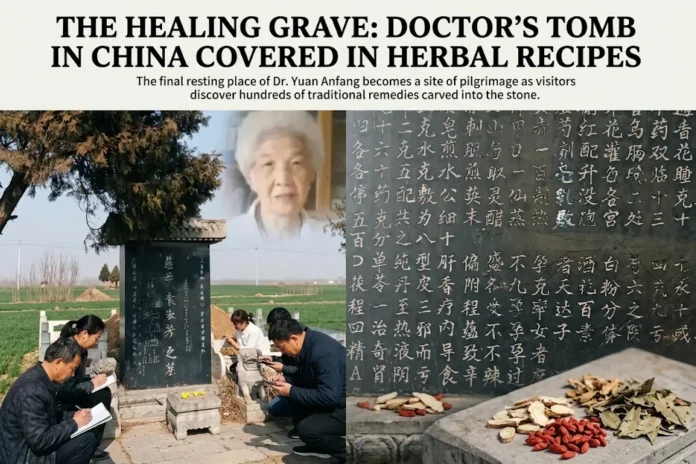
In a cornfield outside Panlongqiao village in Xiping County, Henan, a plain granite stele marks the grave of Yuan Shufang. The front reads simply “Tomb of Kind Mother Yuan Shufang.” The sides and back are packed with dense columns of Chinese characters listing herbal formulas, exact herb names, and precise dosages in grams. Visitors have been photographing and hand-copying those lines since the stone went up in 2008. In early November 2026 the trickle became a surge after local reports, with dozens to more than a hundred people arriving on peak days, some traveling from other provinces and spending full days at the stone.
Yuan Shufang was born around 1909 in the same rural township. She began treating patients at 16 and continued until her death in 2006 at 97, roughly 81 years of practice. Locals called her a “child-giving Guanyin” for her work with infertility and other gynecological conditions. She also treated pediatric cases, osteomyelitis, and stubborn epilepsy, and left short manuscripts on the last two subjects. She married into a traditional-medicine household. Her husband, Wang Mingzhou, was a recognized local practitioner. Initially illiterate, she learned to read from him and studied medicine after farm work, often by moonlight while raising children. An 85-year-old daughter-in-law, Li Guimei, later recalled Yuan comparing careful prescribing to deploying troops: only thorough mastery allowed the right match for a given patient.
Near the end of her life she selected a core set of verified formulas from a red notebook of clinical notes and told her second son, Wang Taisheng, to have them carved on the tombstone. Family members quote her as saying the medicine belonged to everyone and should not go into the ground with her, so later generations could treat illness at little or no cost. The stone carries about 52 independent gynecological formulas; variants and modifications for different syndromes bring the practical total near 100. Space limited what could be inscribed. Relatives, including grandson Wang Kezhong, say a fuller handwritten collection of more than 200 formulas still exists and is being organized. Wang Kezhong, 54, describes himself as the family’s 19th-generation practitioner.
The formulas differentiate by constitution and syndrome rather than offering one recipe per complaint. Obesity-related infertility receives separate approaches for damp-heat versus cold-damp patterns, with herbs such as Anemarrhena, Phellodendron, Atractylodes, and Cyperus in one line and deer antler, tree peony bark, and cinnamon twig in another. Thin or blood-deficient cases get different combinations built around motherwort, Chinese angelica, and fresh peach root. Pregnancy vomiting, postpartum issues, amenorrhea, and dysmenorrhea appear with similar splits. Dosages are listed in full, a break from the common folk practice of passing the formula while withholding the exact amounts. Practitioners who have copied the stone, including a clinic doctor from Luohe named Duan Hongxia, have described the doses as unusually generous and clinically useful after individual adjustment. One dysmenorrhea formula produced practical results in her practice.
Nationally known TCM physician Mao Dexi, 86, reviewed the inscribed material and noted classical foundations alongside Yuan’s own modifications. He observed that many ingredients are ordinary and inexpensive, consistent with a practice aimed at ordinary patients rather than costly rare drugs. He described the collection as the product of tens of thousands of clinical encounters refined over decades. Family members stress the same limit that appears on the free digital memorial now circulating: the stone is a reference for licensed practitioners performing syndrome differentiation. It is not a self-medication guide. Original manuscripts lack modern punctuation, and individual patient differences in pulse, tongue, and constitution require professional judgment.
The site drew steady, low-key visitors for years after earlier local coverage around 2008 and again in 2019. The November 2026 wave followed reports from outlets including Dahe Daily. Within days a Henan university student, working with AI developers and TCM specialists and with family approval, used Qwen tools to photograph, recognize, and verify the inscriptions. The result is a free online memorial titled “Yuan Shufang ‘Prescriptions on the Stele’ Empirical Formula Memorial Book.” It lists the 52 core formulas with dosage variants, supports search by symptom or herb, includes biographical notes, and allows virtual flower offerings. As of mid-November the application had drawn thousands of views and more than 12,000 virtual flowers. Family members continue work on the larger handwritten collection for eventual wider release.
Some circulating photographs of an elderly white-haired woman are not confirmed by the family, which holds only a limited set of verified images. The stone itself remains open in the fields, unstaffed and without set hours. Practitioners treat it as a working outdoor reference library while repeating the same caution: the formulas record one doctor’s long clinical experience under specific conditions. They are tools for study and adaptation by trained hands, not ready-made prescriptions for the public.
Yuan Shufang’s recorded instruction to her family was straightforward. Traditional medicine was not hers alone. The dosages should stay public so later generations could use what she had tested. The granite in the Henan field still carries that request in stone.