

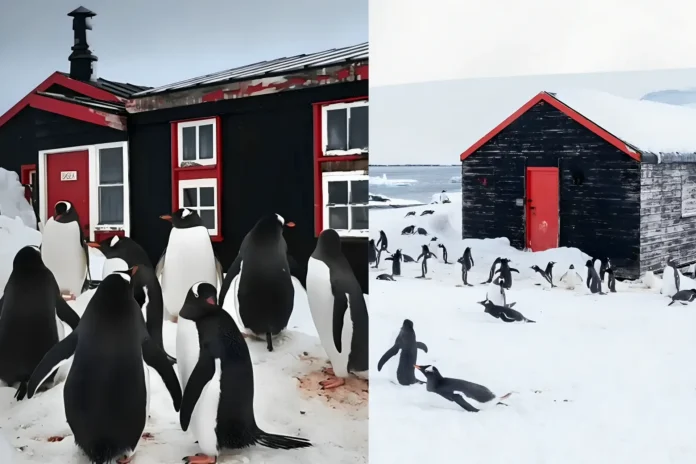
Do you want to earn money by counting penguins in Antarctica? There has been a British charity recruiting staff in seasonal positions that offer up to around $2,800 per month, but there is much more to consider.
The UK Antarctic Heritage Trust (UKAHT) recruits a small team each year for Port Lockroy on Goudier Island, a tiny outpost on the Antarctic Peninsula. Staff spend roughly five months there during the austral summer, typically late October or November through March. The island, about the size of a football field, hosts a colony of more than 1,000 gentoo penguins and operates as a historic site, museum, gift shop, and the world’s southernmost post office.
One such responsibility is penguin observation. Members of the crew count nests, eggs, and chicks during the program which started in 1996 and entered its 30th year. The information will be sent to the British Antarctic Survey to monitor penguins’ population numbers and breeding performance.
There is more to do than that. Employees run Penguin Post Office, process thousands of postcards and letters, operate the museum and the shop, greet tourists coming from cruiseships, take care of the site maintenance, and carry out conservation activities. For the season 2026/27, the eight-member crew of Port Lockroy is planning to repair structural damage to historic buildings caused by climate change and increased snowfall. A field group conducts an examination of another site – Wordie House.
Monthly pay for the 2026/27 season ranged from £1,449 to £2,096 depending on the role base leader, shop manager, wildlife monitor, or general assistant. The upper end converts to roughly $2,600–$2,800 USD at recent exchange rates. Accommodation, meals, polar clothing and equipment, and required transport are provided. These are fixed-term self-employed contracts, so workers handle their own taxes and National Insurance. It is not pure take-home pay.
The environment is intentionally kept simple. There is neither running water nor showers at all. The supply of fresh water is brought by ships coming here. Showering takes place in the same ships approximately once per week; under adverse conditions, it may take as long as two weeks to have a shower in the ship. Toilets are camping type toilets which get emptied out daily. The living quarters are shared within a small tent. The power source is the insufficient solar energy. The temperature is below freezing point, the wind is strong, and communication is limited to satellite telephone only.
Eligibility is strict. Applicants generally need to be UK residents with the legal right to work in the UK by the start of selection. UKAHT does not sponsor visas. The 2026/27 recruitment closed in March 2026; the team of about 14 people (eight at Port Lockroy) has already been selected and announced. The next round is expected in early or spring 2027 via the official UKAHT website.
Port Lockroy itself dates to 1944, when Britain established it during wartime Operation Tabarin to maintain a presence. It later became a research station, then a protected historic site managed by UKAHT. The combination of meaningful conservation work, science, and extreme remoteness draws hundreds of applicants for a handful of spots each year.

