You finish another demo and play it beside the last few. The lyrics tell a different story, but the music takes a familiar route. You reach for the same chords, settle into the same pace and build toward the same kind of chorus. Halfway through, you can almost predict what you will do next.
Having a recognizable style can be a good thing. Your voice, taste and favorite sounds help people connect one song with another. The frustration begins when those choices stop feeling like choices. You want to try something different, yet every session seems to bring you back to the sound you already know.
There are several ways to interrupt that pattern. You can change how a song begins, listen differently to music outside your usual rotation, or hear your own material in an arrangement you would struggle to make yourself. Each gives you something new to respond to before the familiar decisions take over.
Listen for the habit you keep returning to
Start with two or three recent demos and listen across them to hear what keeps repeating. Pay attention to what arrives first, how the vocal moves and what changes when the chorus comes in. Perhaps every song opens with a slow piano pattern. Perhaps you keep singing long notes over held chords, or every chorus gets bigger by adding another layer of guitars.
Give the repetition a plain description. ‘I keep using the same strumming rhythm’ tells you where to begin. ‘I need to become more original’ leaves you with a much harder job. A producer might notice that changing instruments has barely changed the music because the drums still follow the same pattern and every new sound fills the same role.
This helps you decide what kind of change you need. If the melodies feel repetitive, a different keyboard preset may do little for them. If you still like the tune but the backing feels predictable, exploring rhythm and arrangement makes more sense. You now have a reason to try a new direction and a way to judge whether it has helped.
Give the next idea a different starting point
The first thing you play can quietly steer everything that follows. Try interrupting that habit at the start of your next session. If you usually find four chords and sing over them, try putting the instrument aside for a few minutes. Tap a rhythm and sing a line before deciding what chords belong underneath it. Let the tune find its own pauses instead of fitting it immediately to a pattern your hands already know.
You can try the reverse if you always begin with a beat. Sing or speak a phrase first, listen to its natural rhythm, then build the drums around that. A line with an awkward little pause may suggest a more interesting beat than the loop you would normally load. Record the rough idea so you can explore the backing without having to remember the phrase at the same time.
Treat this as a short writing experiment. You may return to your usual instrument once the idea has a shape. The difference is that it is now following something you have already sung. Even if you keep your familiar sounds, the melody may move differently because you made the opening decision in a different order.
Listen beyond your usual references—and keep what you discover
Fresh ideas also depend on what you are taking in. Choose a recording outside your usual style that you actually enjoy, and listen for one thing you want to understand. You might be drawn to a chorus that feels bigger even though the backing stays sparse, or a slow song whose drums still make you want to move.
Keep a listening journal for those discoveries: a collection of musical moments you want to understand and try in your own work. Save the song and timestamp, describe what happens, then add why it interests you. You do not need to analyze every part of the recording. Start with the few seconds you wanted to hear again.
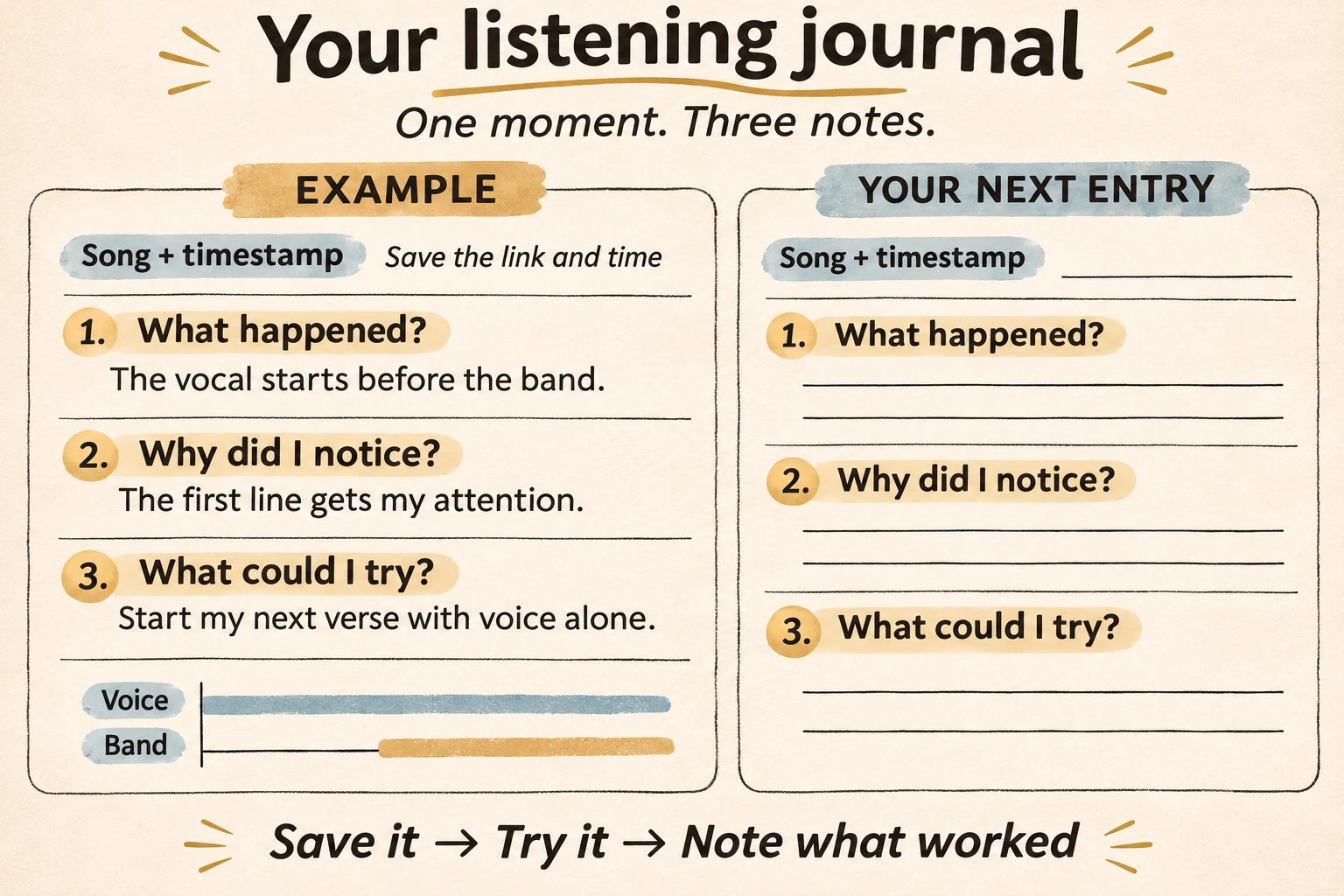
Save one musical moment, describe why it caught your ear, and choose something to try.
“Great opening” is easy to forget. “The singer starts immediately, and the band enters halfway through the first line” gives you something to return to. If your songs usually begin with an instrumental intro, that note offers another way in. Later, you can try starting with the voice and hear whether the opening lyric is stronger without the lead-in. An intro can still be right for the song; the discovery gives you a choice you might otherwise overlook.
Harmony belongs in the journal, too. If you keep writing over a familiar Canon-style progression, notice songs whose chords take a different route. Work out the sequence if you can and play it yourself. Note the movement that caught your ear, or the point where a chord lasts longer than you expected. You can try writing over that progression with your own melody. There is no need to force an out-of-key chord into a song just to make it seem adventurous.
Sometimes the melody and chords are familiar, but the arrangement makes them feel fresh. A guitar may answer the singer between lines instead of strumming continuously underneath. Listen to what the bass and drums do while the guitar waits. This is something you can explore without discarding a tune you already like. A note about how the parts share the space is more useful than simply saving the guitar’s tone as a reference.
A transition can be worth a note of its own. During a build-up—the passage that increases tension before a chorus or drop—you may expect the layers to keep growing until the next section hits. A recording might instead go quiet for a beat before the kick and bass arrive. Note what disappears, what remains and where to start playback to hear the lead-in. The pause makes sense in relation to what comes before it; a timestamp at the drop alone misses that relationship.
Lyrics and rhythm offer more possibilities. A verse of long, conversational sentences might lead into a chorus built around one short phrase. A bass line might answer the kick rather than land with every hit. Collect the choices that interest you, in language you understand. A brief note, a chord chart or a rough recording of yourself trying the idea can all help you remember it.
Bring one discovery back to a song you are working on. You might combine a vocal-first opening from one reference with the guitar responses you noticed in another, using your own words and melody. Try whichever idea serves the song, then add a short note about what worked. Over time, connections like these give you more ways to write and arrange. The journal stays useful because its contents come from things you actually wanted to hear, rather than a checklist of techniques you feel obliged to use.
Use AI to hear an unfamiliar direction
A reference or a journal entry can give you a direction before you know how to produce it. Perhaps you want to try those guitar responses over a light electronic groove, but your demo is just acoustic guitar and voice. Building all the drum and synth parts yourself can feel like a lot of work when you only want to test an idea. An evening can pass before you know whether the direction suits the song.
You can explore that arrangement with an AI music generator before programming all the parts yourself. For an existing recording, choose Change style on the homepage to open Music Remixer, upload your own demo and describe the new backing you want to try. Hearing a rough version helps you decide whether the direction interests you before producing the full arrangement.
Give the request more detail than a genre name. For the guitar demo, a possible direction is:
Electronic R&B with a light, skipping drum pattern and rounded synth bass. Short, muted guitar answers between vocal phrases rather than continuous strumming. Keep the vocal close and conversational, with space between lines. Let the final chorus phrase stretch over a sustained chord.
This asks for a different rhythmic feel and a different way of supporting the voice. Listen to the spaces between sung lines. Do the drums keep the song moving there, or do the fills crowd the next vocal entrance? You may also find that the electronic sound fights the words. You might keep the guitar responses but ask for fewer drum fills, rather than abandoning the whole direction.
Keep the original demo available. A remix can change the melody, phrasing or structure as well as the backing; the recording guides the result rather than fixing every note. If you only have lyrics so far, you can use Own Lyrics to hear them in a musical setting, entering the words separately from the style description.
Listen for a direction you could develop. That might be the pace of the drums, a new mood or the way a small arrangement gives the vocal more presence. If something catches your ear, try singing with that kind of backing yourself. How it feels to perform can help you decide whether the change belongs in your music.
Hear what another musician would do
Working with another person can bring a different set of habits into the room. A drummer may hear movement where you have been concentrating on chords. A singer may shorten a line you always stretch out. A guitarist may play a few brief accents where you have been filling the whole bar. Those responses can change the song before anyone chooses a genre label.
Give a collaborator room to respond, along with a clear problem. You could send a rough vocal and say, ‘My last few songs all turn into piano ballads. I want this one to feel more restless, but I still want the words to be clear.’ That gives them a purpose without prescribing every part before they have heard the song.
If you are working alone, an outside listener can still help you hear your choices. Play a rough version and ask what mood it suggests or where their attention goes. Keep your original intention in mind, especially when someone prefers a polished version that takes the story somewhere you never wanted it to go. Ask which words or musical moments gave them that impression; that is more useful than a vote for the most polished track.
Decide what belongs in your song
After trying something unfamiliar, return to the words and the melody you care about. Does the new rhythm make you want to sing the line differently? Can you still hear the feeling that made you write it? An arrangement can be exciting on its own and make the singer sound too cheerful, too detached or too grand for the story.
Keep the changes that work together. You might use the electronic rhythm with a real guitar, or keep your original melody while rebuilding the chords around it. Add a note about the choice you made, so the next time you return to that reference, you remember what you learned from trying it.
As you keep doing this, give the unfamiliar parts some practice time. A new groove may feel awkward to sing over at first, and an arrangement you admire may take a few attempts to understand. Your own voice and interests can stay recognizable while the music around them grows. Keep a short recording of the change you liked. At the next session, play that passage before reaching for your usual chord pattern.