

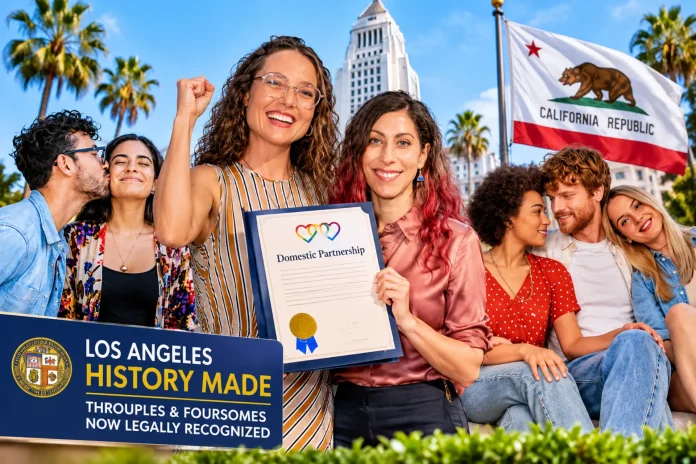
West Hollywood’s city council voted 5-0 this week to open a domestic partnership registry for polyamorous relationships, giving groups of three or more adults a way to formally record their partnerships with the city and pick up a narrow set of local protections.
The ordinance, introduced by Mayor John Heilman, creates a new category called multi-partner domestic relationships. Three or more people can file paperwork with the city clerk. Everyone has to be at least 18, the arrangement has to be mutual, and no one can be related by blood in a degree that would bar marriage under California law. They also have to share responsibility for one another’s welfare. Partners do not have to live at the same address, and people who live outside West Hollywood can still register.
What they get is limited. The registry does not create marriage or the full rights that come with California’s existing two-person domestic partnership law. There are no automatic tax breaks, inheritance rights, or employer health insurance. Healthcare facilities inside the city’s jurisdiction must allow registered partners to visit a patient. City jails have to recognize visitation. Landlords face restrictions on ending or refusing to renew a lease simply because one partner stays behind after another leaves.
The vote builds on a March 2026 anti-discrimination ordinance that added “family or relationship structure” as a protected class in housing, healthcare, and education. Attorney Christina Fialho, who runs the bisexual media group Rewrite the BiLine, first brought the idea to Councilmember Chelsea Lee Byers early last year. Fialho told the Los Angeles Times the new law is “just the beginning” and that it “makes it possible for people to dream about a future they once thought was out of reach.” Byers has called the protections long overdue.
West Hollywood has done this kind of thing before. In 1985 it became the first U.S. city to set up a domestic partnership registry for same-sex couples. The multi-partner version follows a similar local model. Somerville and Cambridge in Massachusetts already run multi-partner registries. Berkeley and Oakland have anti-discrimination rules based on family structure.
Megan Katz, a West Hollywood librarian with two children and a second partner outside her marriage, supported the measure. She and others pointed out that the language focused on groups of three or more and asked for room for people who keep separate two-person relationships. Byers said the city would look at amendments to cover that.
The ordinance leaves bigger legal questions untouched. Property, child support, and what happens when a multi-person relationship ends still fall under state law. Critics who opposed similar steps in other California cities have argued that formal recognition moves away from traditional family structures. West Hollywood’s version stays local and voluntary. It gives people a paper record and a few city-controlled rights while the rest of California’s marriage and family law stays the same.
The measure takes effect after the usual waiting period. City officials have not yet published exact filing instructions or any estimate of how many people will use it.
