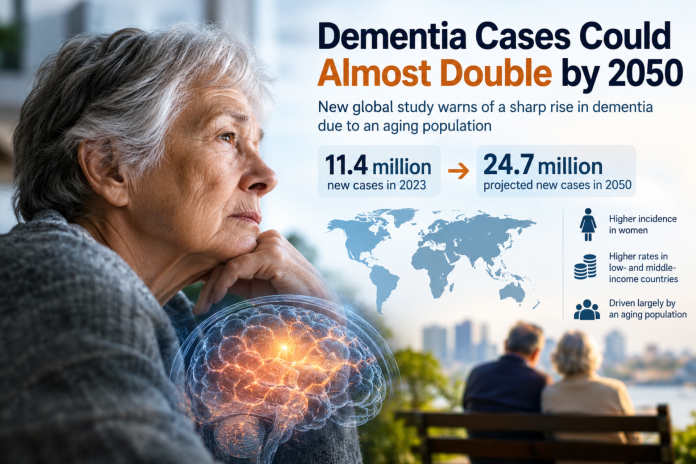
Based on scientific estimates, there were 11.4 million cases of dementia around the world in 2023, but by 2050, the yearly occurrence may hit 24.7 million almost doubling due to the findings of an international study reported on October 12 in JAMA Neurology.
The reason behind the increase is the process of aging. There are more people reaching old age, thus becoming part of the risk group for the disease. Such a scenario is based on the assumption that current rates will remain constant while the population structure changes.
Researchers from UNSW Sydney’s Centre for Healthy Brain Ageing (CHeBA), working through the COSMIC consortium, analyzed individual data from 38,418 participants across 22 population-based studies in 18 countries and territories. Over more than 287,000 person-years of follow-up, 3,001 people developed dementia. The global age- and sex-standardized incidence rate came in at 9.7 new cases per 1,000 person-years.
Women had higher incidence than men 10.6 compared to 8.6 per 1,000 person-years after adjusting for age. The difference in rates was even more pronounced according to income level. While low- and middle-income countries reported 13.6 cases per 1,000 person-years, the rate in high-income countries was 8.3.
“We can now quantify dementia incidence rates between different geographic groups of populations in a consistent statistical method. This means we can better understand where new cases are arising,”
Says Dr. Ashleigh Vella, lead author of the study and postdoctoral research fellow at CHeBA.
“What is interesting is that dementia incidence is uneven. We are seeing increased incidence among women and lower and middle-income countries.”
The above figures are measures of dementia incidence new cases developing annually. They are distinct from prevalence, which denotes the total number of people living with dementia. There are currently over 57 million people living with dementia. Previous projections suggested this figure would be near 150 million in 2050.
Professor Henry Brodaty, CHeBA co-director and 2026 Senior Australian of the Year, underscored the stakes.
“Twenty-four million new cases of dementia every year would place enormous pressure on individuals, families, health systems and economies around the world. Population ageing means we cannot simply wait for people to develop dementia and then respond. We need to act across the spectrum from reducing modifiable risk factors and identifying people at risk earlier, through to improving diagnosis, treatment and care.”
Lead author, Professor Perminder Sachdev noted that high rates in low-income countries were of particular concern since these countries were rapidly aging yet had less means for prevention and treatment.
The forecast is not set in stone. It is based on the hypothesis that age and sex-specific rates will stay the same. Risk factor management, early screening or development of novel treatments could affect it. This particular study does not identify the reasons behind the difference in sex and income groups. Rather, it highlights the complexity of the problem and indicates that various health, socio-economic, educational and environmental variables require further research.
From an American point of view, this information is helpful. Any aging society requires more services like memory clinics, long-term care facilities and help for caregivers. Global figures show areas where prevention and care services are lacking. They emphasize the importance of risk modification (blood pressure, hearing, education, physical and cognitive activity, social integration).
Preparation, prevention research, earlier diagnosis, and stronger care systems remain the clearest path forward. The numbers are large. The window to respond is still open.