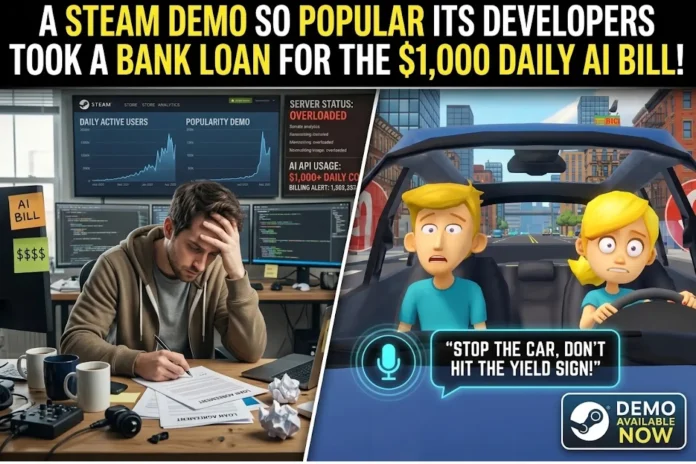
The developers of Teach My Little Sister How To Drive have taken out a bank loan to keep their free Steam demo running after its growing popularity pushed artificial intelligence (AI) expenses above $1,000 per day. The four-person indie team behind the game, Easy Fox, says player numbers have increased more than twentyfold in a month, creating operating costs far beyond what the developers expected.
The developers disclosed the financial strain in an October 7 Steam community update. They explained that the rising number of players had significantly increased their AI service bills, forcing them to borrow money to keep the demo available while they work toward the full release.
“We are currently spending over $1,000 per day on AI services for the demo,” the team wrote in its official Steam community update.
The game puts players in the passenger seat while a digital younger sister attempts to drive through increasingly difficult situations. Instead of controlling the vehicle directly, players use a microphone to give her spoken instructions. AI processes their commands and generates responses, allowing the character to react to players in real time.
That voice-driven approach has helped the game attract attention from players and livestreamers. Gaming outlet Dexerto reported on October 11 that the demo’s popularity had surged, with streamer CaseOh among the content creators who played it on stream.
However, the attention has created an unusual financial problem for Easy Fox. Every additional player can generate more requests to external AI services, adding to the cost of keeping the experience running. Although the developers said individual players are not particularly expensive to support, the combined demand has pushed the demo’s daily bill beyond $1,000.
The team has also encountered technical limitations with its AI providers. According to Dexerto, Google Gemini was initially the primary model used by the game, but usage limits forced the developers to rely more heavily on an OpenAI model as a fallback. The change reportedly brought problems of its own, including lengthy responses, unnatural dialogue and instances in which the digital sister misunderstood instructions.
Those issues present a difficult challenge for a game built around natural conversation. Players need the character to understand spoken directions and respond quickly enough to make driving challenges playable. When the AI service reaches its limits or produces inconsistent responses, the developers must balance performance, reliability and cost while maintaining the experience that attracted players in the first place.
Easy Fox has not announced a final decision to shut down the demo early. However, the developers warned that their financial situation could force them to remove it before the full game launches.
“We want to continue operating the demo and would love for more people to enjoy it,” the team said in its Steam update. It also acknowledged that the studio’s small size and mounting financial pressure could make that difficult.
The developers plan to account for AI expenses in the price of the full game rather than charge buyers separately for their individual AI usage. Under that approach, customers would pay for the game itself, with the expected cost of running its AI features factored into the purchase price.
The game’s Steam store page describes it as a voice-driven driving simulation featuring real-time conversations, multiple driving courses and increasingly difficult challenges. The listing identifies Easy Fox as both developer and publisher and discloses its use of third-party AI content generation through the Gemini API.
For now, the situation highlights a cost problem that can emerge when an AI-powered game becomes unexpectedly popular. Traditional game development expenses do not necessarily rise with every conversation a player has, but cloud-based AI services can charge developers according to usage. A free demo that attracts a large audience can therefore become a substantial recurring expense before the studio earns revenue from sales.
Easy Fox’s experience illustrates the trade-off facing developers who build games around interactive AI. The technology can create conversations and unpredictable character reactions that help a game stand out, but supporting those features at scale requires a sustainable business model. Until the full release arrives, the four-person team must decide how long it can afford to keep its increasingly popular demo free.