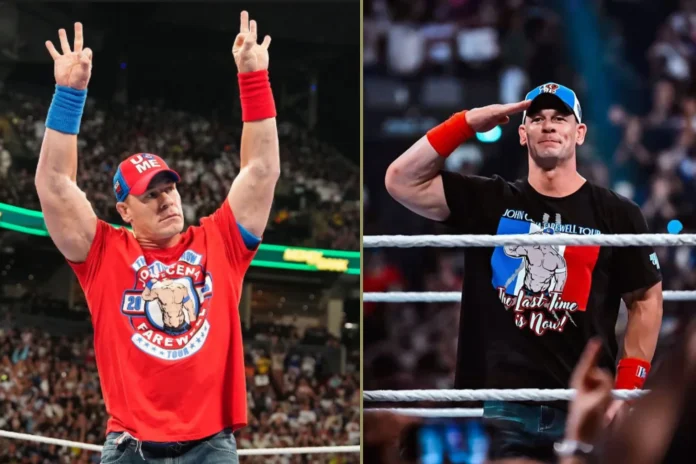
John Cena has opened up in detail about the precise factors that led him to permanently retire from in-ring competition, emphasizing that hard athletic performance data—not emotion or external pressure—drove the decision.
In recent interviews, including an appearance on the Happy Sad Confused podcast and other discussions throughout 2026, the 17-time world champion explained that he has long tracked objective metrics as a dedicated strength athlete. These include one-rep max lifts, vertical jump, sprint times, and recovery periods between performances.
“I’m 49. I’m slower. My vertical jump was down. My overall strength was down, which means my body—essentially, time is undefeated,” Cena said. “My body is getting weaker, and it takes longer to perform, longer to warm up to perform, and longer to recover between performances. All of these things are data that’s hitting me in the face. And those times, those numbers, the strength numbers are never going back up.”
Cena noted that he could still deliver solid matches with extended preparation and recovery, but the trajectory was clear. Continuing indefinitely risked delivering diminished performances to paying audiences. “When is the math going to not work? And at that point, gosh, people are paying a lot for tickets, and I’m robbing them of that investment,” he explained. “Let’s close this chapter while we still can do great work.”
This data-focused approach aligned with a long-standing personal promise. Early in his career, Cena vowed he would not “do bad work” or “selfishly hang on for my own ego and just to feed my own thing and take away from everybody else.” He has repeatedly described professional wrestling as a team effort and viewed stepping aside as the most passionate way to honor the business that gave him a quarter-century of opportunity.
The physical realities became harder to ignore after he married. When single, an injury affected only him. As part of a partnership, he prioritized responsible decisions that maximized time with his wife. Preparing for and recovering from shows had already grown more demanding, reinforcing that the schedule was no longer sustainable at the level he demanded of himself.
Cena announced his retirement plans in 2024 and embarked on a year-long farewell tour in 2025, culminating in his final match against Gunther at Saturday Night’s Main Event on December 13, 2025. He deliberately chose a December exit over a WrestleMania send-off, calling the latter “selfish” because WrestleMania sells itself. Placing a major event in WWE’s traditionally softer fourth-quarter period, he argued, better served the company’s business interests.
Since retiring, Cena has remained firm that the decision is permanent. He has rejected any notion of a return, stating that coming back for money or ego would betray fans who invested in his farewell. He continues to miss performing daily but maintains that emotional attachment does not override the data or his principles.
Cena’s reflections underscore a career defined by discipline. By relying on measurable athletic decline rather than nostalgia or external validation, he exited the ring on his own terms—while still capable of strong work—and cleared the path for the next generation.