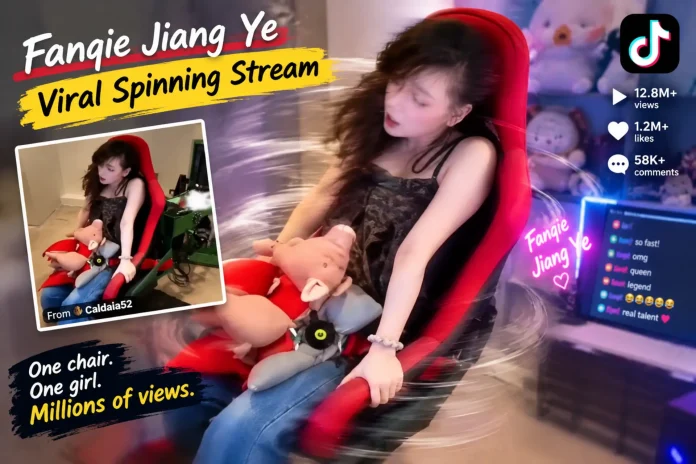
A Chinese livestreamer known as Fanqie Jiang Ye has drawn widespread attention after setting up a motorized gaming chair that spins whenever viewers donate the equivalent of about $7.50.
Clips from her streams show her strapped into a red racing-style seat with a harness across her chest and a stuffed animal in her lap. Each qualifying donation triggers a rotation of the chair. When multiple viewers sent the payments in quick succession, the mechanism kept activating, leaving her spinning nearly nonstop.
In the videos that circulated widely this week, Fanqie Jiang Ye appears laughing at first. As the spins continue, her long hair flies outward, her head sways, and she grips the armrests while looking increasingly dizzy. At times the continuous motion has drawn comparisons to a centrifuge or astronaut training.
The feature costs roughly 50 yuan per spin, or about $7.50. Viewers on Chinese platforms used the low price point to trigger repeated activations, turning what began as a novelty into an extended physical challenge during the broadcast.
The footage first spread through Chinese social media before English-language accounts shared it on X. An Oct. 8 post from the account @BurgerFcts helped the clips circulate, and the versions that followed drew the biggest audiences: a post by @scubaryan_ describing the nonstop spinning had collected more than 26,000 likes within a day, with view counts reported in the millions. Mario Nawfal, whose Oct. 9 post was among the widely shared versions, summed up the genre anxiety in a line:
“I dread to think what the next thing to top this will be.”
Fanqie Jiang Ye, also referred to in Chinese as 番茄酱耶 or similar variations, appears to stream on platforms popular in China. Public details about her age, real name or background remain limited beyond her online persona as a livestreamer who incorporates interactive physical challenges into her broadcasts.
The setup relies on a mechanical system linked to the donation interface. In the clips, consecutive gifts keep the chair rotating without long pauses, forcing the streamer to endure the motion while continuing the broadcast. Viewers have noted the simplicity of the gimmick and the direct physical response it produces.
The honest caveat, according to TechSpot, is that the original livestream has not been independently verified, and the available clips do not establish exactly how payments trigger the chair, whether the creator can pause its movement, or how stacked payments are handled while it is already moving.
Similar donation-triggered stunts are common on Chinese live platforms, where audiences often pay for dances, food challenges or endurance bits. This version stands out because the chair removes much of the performer’s control once the payments begin stacking.
The comparison that dominated the English-language reaction, per reaction coverage, was not astronaut training but Black Mirror, specifically the episode “Common People,” in which a subscriber’s recurring payments control a person’s experience. The parallel is loose but the discomfort is recognizable: a payment buys a physical effect on another person, the price is low enough to stack, and the performer’s consent to one spin does not cover the fifty that follow. Fellow streamers joked about trying the setup themselves while trading safety tips about securing long hair.
The endurance-spectacle lane is crowded on this side of the Pacific too. Hypefresh has tracked an endurance challenge where the last person to stop listening won $100,000, a 2,000-participant endurance stunt built for attention, and a stream-event injury that drew its own response from the host. Fanqie Jiang Ye’s chair sits at the cheap end of the same spectrum, minus the prize pool and the branded setup.
Reactions online have mixed amusement with comments about the physical toll. Some observers pointed out that the price point made repeated spins easy to sustain, while others joked about the stream resembling pilot training. No reports indicate the streamer has stopped using the feature or faced platform restrictions over it.
The clips continue to circulate across X, TikTok and other sites, keeping the spinning-chair streams in circulation days after the initial surge of attention.