

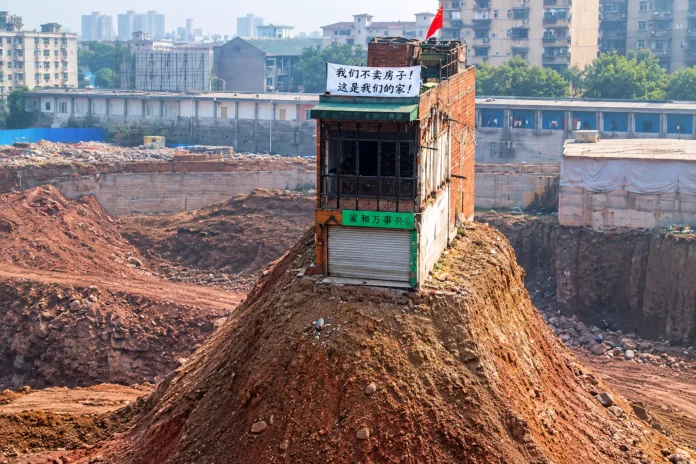
CHONGQING, China , Demolition crews tore down a two-story brick house in early April 2007 that had become a national symbol of resistance after its owners refused to sell for a shopping mall project, reducing the structure to rubble within hours of a negotiated settlement.
The house, left stranded on a roughly 10-meter earthen pillar amid a vast excavation pit in the Yangjiaping neighborhood of Jiulongpo District, belonged to Wu Ping and her husband, Yang Wu. They had held out since 2004 as the sole remaining household among roughly 280 others near the Yangjiaping light rail station. Developers clearing the site for a commercial complex often referred to as Zhengsheng Broadway excavated the surrounding land and cut off water and electricity, isolating the building on a dirt mound, according to historical records.
Yang Wu, a former local martial arts champion then in his early 50s, reoccupied the house in mid-March 2007 after a court order. He climbed the steep sides using makeshift steps and tools including nunchakus, raised a Chinese national flag on the roof, and hung a banner declaring that citizens’ private property rights must not be violated. Supporters lowered food, water, and supplies by rope while he remained inside.
Wu Ping, then in her late 40s and the more public face of the couple, spoke frequently with Chinese and international media. She had run a restaurant from the ground floor of the house, which the Yang family had long occupied. The property traced its roots to a wooden structure Yang Wu’s father acquired around 1944; the couple rebuilt it in brick in 1993. Wu Ping rejected early compensation offers, seeking either equivalent commercial space on the original site or higher payments that some reports placed as high as 20 million yuan.
The Jiulongpo District Court ordered the couple to vacate by March 22, 2007, after the developer sought administrative relief through the local housing bureau. The standoff drew intense online and media attention just as China’s National People’s Congress passed a landmark property rights law. Photographs of the isolated “nail house” — a term for holdouts that refuse to yield — spread widely and prompted public debate over urban redevelopment and individual rights, echoing property-rights disputes worldwide.
On the afternoon of April 2, 2007, a Monday, after multiple rounds of court-mediated talks, the couple reached an agreement with the developer. Wu Ping and Yang Wu accepted a similarly sized apartment in Chongqing’s Shapingba District, valued at approximately 3.06 million yuan, along with additional payments. These included about 900,000 yuan for business losses calculated over 30 months, plus smaller sums for moving costs, equipment, and decoration. Reports placed the overall package near 3.5 million yuan. The couple left the site that afternoon.
Demolition began that evening. An earthmover reduced the house to rubble over roughly three hours as a small group of onlookers and reporters watched. Local court officials later described the outcome as a mediated resolution that addressed both the developers’ project timeline and the homeowners’ claims. Wu Ping told interviewers after the settlement that she had defended her rights as a citizen while also considering broader interests.
The case remains one of the most documented examples of a Chinese “nail house,” joining other landmark cases that shaped legal precedent. It highlighted tensions between rapid urbanization, developer interests, and private property claims in the mid-2000s, reflecting broader transformations in Chinese cities. Contemporary coverage from state and international outlets, along with detailed reporting in Southern Weekend, recorded the sequence of negotiations, the physical isolation of the home, and the final terms that cleared the way for construction,

